Pori

- Molluscum contagiosum is a viral skin infection that causes small, firm, dome-shaped bumps, often with a dimple in the center; it is most common in children aged 1 to 10.
- It spreads by skin contact, shared towels and toys, and scratching or shaving; the bumps stay contagious until they are all gone.
- Most cases clear without treatment within 6 to 18 months; picking or squeezing raises the risk of infection and scarring.
- The FDA approved Ycanth (cantharidin, applied in the office, ages 2+) in July 2023 and Zelsuvmi (berdazimer gel, used at home, ages 1+) in January 2024.
Molluscum contagiosum is a common viral skin infection that causes small, firm, dome-shaped bumps, often pink, white or skin-colored, many with a tiny dimple in the center. It is most common in children aged 1 to 10, spreads through skin contact and shared items, and usually clears on its own within 6 to 18 months. Since 2023 the FDA has approved two prescription treatments for it: Ycanth (cantharidin) and Zelsuvmi (berdazimer gel).
Pori does not diagnose skin conditions; its selfie scans and photo diary in Pori can help you keep dated, consistent photos to show a dermatologist and see whether treatment is working.
This guide covers what molluscum looks like on different skin tones, how it spreads, the conditions it is confused with, and what the newer treatments involve.
What does molluscum contagiosum look like?
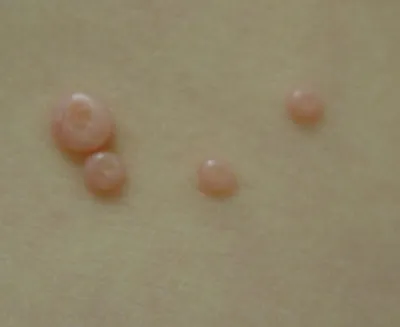
The bumps are small and smooth. The NHS describes them as about 2 to 5 mm across, raised and dome-shaped with a shiny white dimple in the middle. The CDC puts the size range at about the size of a pinhead to a pencil eraser, and notes they feel firm. They are usually painless, though they can itch.
- Shape: round, pearly domes, often with a central dent (called umbilication).
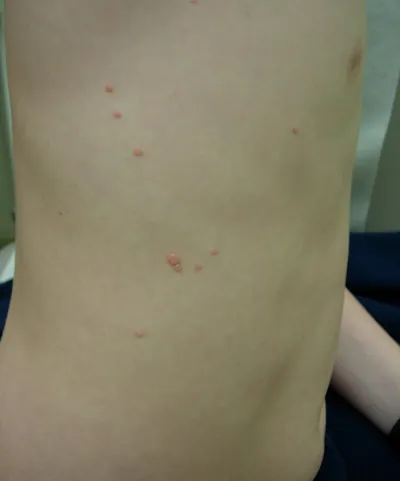
- Number: a few to dozens, often in groups or lines where scratching has spread them.
- Surrounding skin: DermNet notes the bumps frequently induce dermatitis around them, so the skin nearby can turn pink, dry and itchy.
How molluscum looks on brown and black skin
On lighter skin the bumps tend to look pink or pearly white. DermNet notes they can also be brown. On brown and black skin, color is a less reliable clue, so look for the shiny, smooth dome and the central dimple, and feel for firm bumps. Redness around the bumps can be harder to see on darker skin, even when the skin is itchy and irritated. The AAD notes that laser treatment can cause temporary color changes in people with darker skin tones, which matters when choosing a treatment.
Where on the body does it appear?
Molluscum can appear almost anywhere. The CDC says it rarely appears on the palms or soles. The AAD notes bumps can even appear on the lining of the eyelids. In adults, bumps in the genital area are often spread by sexual contact, and the CDC advises prompt medical care for them. Widespread bumps on the face in an adult can be a sign of a weakened immune system: DermNet notes the infection can be very extensive in people with HIV or other causes of poor immune function.
How do you get molluscum, and is it contagious?
Yes, it is contagious. A virus causes it, and it spreads in three main ways:
- Skin-to-skin contact with someone who has the bumps.
- Shared items: the CDC lists towels, clothing, toys and pool equipment, and the AAD adds wrestling mats and kickboards.
- Self-spread: scratching, picking, shaving over the bumps or hair removal can move the virus to new areas of your own skin.
DermNet gives an incubation period of about 2 weeks, but it can be as long as 6 months, so it is often hard to tell where it came from. The AAD says the bumps are contagious until all of them are gone.
Anyone can get molluscum. The CDC says it is most common in children aged 1 to 10, and risk is higher with eczema, a weakened immune system, or warm, humid climates with crowded living conditions. Children with molluscum do not need to stay home from school or daycare, the CDC says, and they can swim if they have no open sores. The NHS suggests covering the bumps, including with waterproof bandages for swimming, and not sharing towels.
Is it molluscum or something else?
| Condition | How it differs from molluscum |
|---|---|
| Warts | Rough or flat-topped, no central dimple; filiform warts have thread-like spikes |
| Milia | Hard, white, seed-like dots under the surface, usually around the eyes; no dimple and they do not spread |
| Closed comedones | Skin-colored bumps in oily areas such as the forehead and chin, part of acne |
| Folliculitis | Small pus bumps centered on hair follicles, often after shaving or sweating |
| Keratosis pilaris | Tiny, rough, sandpaper bumps spread evenly on the upper arms, thighs or cheeks |
| Sebaceous hyperplasia | Yellowish bumps with a central dip in adults, on the forehead and nose; not contagious |
| Cold sores | Clusters of fluid-filled blisters on the lip that tingle, burst and crust within days |
For more possibilities, see our guide to bumps on the face that are not acne.
Does molluscum go away on its own?
Usually, yes. The CDC says the bumps typically go away in six months to a year, and the AAD says most people clear without treatment, usually within 18 months. DermNet reports that in children about half have cleared by 12 months and two-thirds by 18 months. The bumps usually do not scar unless they are picked or get infected.
As the bumps start to clear, they may look red and swollen, which the AAD says is a sign the immune system is fighting the virus. DermNet notes they can become inflamed, crusted or scabby for a week or two. This is different from a bacterial infection, which tends to get more painful, spread and ooze. Because clearing can take a long time, and the bumps can return or be caught again, many families choose treatment, especially when there are many bumps, itching, eczema, or bumps in visible places.
What are the FDA-approved treatments for molluscum?
Until 2023 there was no FDA-approved treatment for molluscum, and doctors used older methods off-label. Two prescription products are now approved. The AAD notes that the FDA has only approved prescription medicines for molluscum, so be wary of over-the-counter products that claim otherwise.
Ycanth (cantharidin 0.7%), approved July 2023
The FDA announced Ycanth as the first FDA-approved treatment for molluscum in July 2023. The label covers adults and children 2 years and older.
- Who applies it: only a health care professional, in the office. It is a blistering agent that comes in a single-use applicator.
- How often: a single application to each bump every 3 weeks as needed.
- Aftercare: the DailyMed label says to wash it off with soap and water 24 hours after treatment, or sooner if there is severe blistering or pain.
- What to expect: the treated bumps blister on purpose. Local skin reactions such as blistering, pain, itching, scabbing and redness were seen in 97% of people treated in the trials. It is not for use near the eyes or on mucous membranes, and the label warns it is flammable even after it dries.
Zelsuvmi (berdazimer gel 10.3%), approved January 2024
Zelsuvmi was approved on January 5, 2024, according to Dermatology Times, as the first prescription molluscum treatment that patients or caregivers can apply at home. The label covers adults and children 1 year and older.
- How it is used: equal amounts from two tubes are mixed on a dosing guide and applied in a thin layer once daily to each bump for up to 12 weeks, per the DailyMed label.
- Side effects: mostly at the application site. The label lists pain, including burning or stinging (18.7%), redness (11.7%), itching (5.7%), peeling (5.0%) and dermatitis (4.9%).
Other treatments a dermatologist may use
The AAD lists several other options, chosen by age, number of bumps and location:
- Cryotherapy: freezing with liquid nitrogen every 2 to 3 weeks; it can be painful, so it is seldom used for many bumps.
- Curettage: scraping the bumps off, usually in older children, teens and adults.
- Pulsed dye laser: for many bumps or hard cases; it can cause temporary color changes on darker skin.
- Prescription creams: tretinoin is sometimes used. Imiquimod is not recommended for children, and studies suggest it works poorly in them.
- Oral cimetidine: occasionally considered for severe eczema with widespread molluscum.
If eczema develops around the bumps, a doctor may also treat that, since scratching itchy skin spreads the virus. The NHS mentions a steroid cream for itchy, dry or sore skin around the spots.
What can you do at home?
- Do not squeeze or pick. The NHS warns this can cause infection or scarring, and the AAD warns that removing the core at home can spread the virus.
- Keep bumps covered with clothing or a bandage during contact sports and swimming.
- Do not share towels, washcloths, razors or bath toys.
- Avoid shaving over the bumps, which spreads them along the shaving line.
- Treat dry skin and eczema with a fragrance-free moisturizer, since itch leads to scratching. Our eczema on the face guide covers the basics.
- Skip internet remedies. The CDC says they may be ineffective or harmful.
Taking a photo of the same area every week or two, in the same light, makes it easier to see whether the bumps are clearing or spreading.
When should you see a doctor about molluscum?
See a doctor or find a dermatologist if:
- bumps are on or near the eyelids, or in the genital area;
- bumps become very painful, swollen, oozing or crusted, or there is fever, which can mean a bacterial infection;
- you have a weakened immune system, or an adult has many or large bumps on the face;
- a child has eczema that is flaring around the bumps;
- you are not sure the bumps are molluscum.
Frequently asked questions
What does molluscum contagiosum look like?
Small, firm, smooth bumps about 2 to 5 mm across, often pink, white or skin-colored, with a tiny dimple in the center. On brown and black skin they can look skin-colored or slightly darker. They often appear in groups.
How long does molluscum last?
The CDC says the bumps typically go away in six months to a year, and the AAD says most people clear within 18 months without treatment. Some cases last longer, and the bumps can come back.
Can my child go to school with molluscum?
Yes. The CDC says children with molluscum do not need to stay home, and they can swim if they have no open sores. Covering the bumps and not sharing towels helps prevent spread.
What is the new treatment for molluscum?
The FDA approved Ycanth (cantharidin 0.7%), applied by a health care professional every 3 weeks as needed, in July 2023, and Zelsuvmi (berdazimer gel 10.3%), applied at home once daily for up to 12 weeks, in January 2024.
Should I squeeze molluscum bumps?
No. Squeezing or picking can cause infection and scarring and spreads the virus to new skin. A dermatologist can remove the bumps safely if treatment is needed.
Can adults get molluscum on the face?
Yes, though it is less common. Many or large bumps on an adult's face can be a sign of a weakened immune system, so an adult with facial molluscum should see a doctor.
Sources
- CDC: About Molluscum Contagiosum
- American Academy of Dermatology: Molluscum contagiosum: Overview
- American Academy of Dermatology: Molluscum contagiosum: Diagnosis and treatment
- NHS: Molluscum contagiosum
- DermNet: Molluscum contagiosum
- FDA: FDA approves first treatment for molluscum contagiosum
- DailyMed: YCANTH (cantharidin) topical solution label
- DailyMed: ZELSUVMI (berdazimer) topical gel label
- Dermatology Times: FDA approves berdazimer gel 10.3% for the treatment of molluscum contagiosum
Pori is a wellness and skincare education app, not a medical device. This article is for general information and isn't medical advice. For anything that worries you, see a dermatologist.