 Pori

- Keratosis pilaris (KP) is a harmless condition in which plugs of dead skin form in hair follicles, causing rough, sandpaper-like bumps, most often on the upper arms and thighs, and on the cheeks in children.
- Bumps can be skin-colored, red on lighter skin, or brown to dark on brown and black skin; KP rubra faceii adds redness across the cheeks.
- It runs in families, is linked to dry skin and eczema, often improves in summer and isn't contagious.
- Moisturizers with urea or lactic acid, applied right after bathing two or three times a day, and gentle exfoliation help; results take 4 to 6 weeks and need ongoing care.
Keratosis pilaris (KP) is a common, harmless skin condition that causes small, rough bumps, a texture people often call "chicken skin". The bumps are plugs of dead skin cells inside hair follicles, and they usually appear on the backs of the upper arms and the fronts of the thighs; children often get them on the cheeks. KP can't be cured, but regular moisturizing with urea or lactic acid and gentle exfoliation make the skin smoother.
Pori does not diagnose skin conditions. The selfie scans and photo diary in Pori can help you keep dated, consistent photos to show a dermatologist and to see whether a new routine is actually working.
This guide covers what KP looks like on different skin tones, the facial form called keratosis pilaris rubra faceii, what causes it, the look-alikes, and the treatments that help.
What does keratosis pilaris look like?
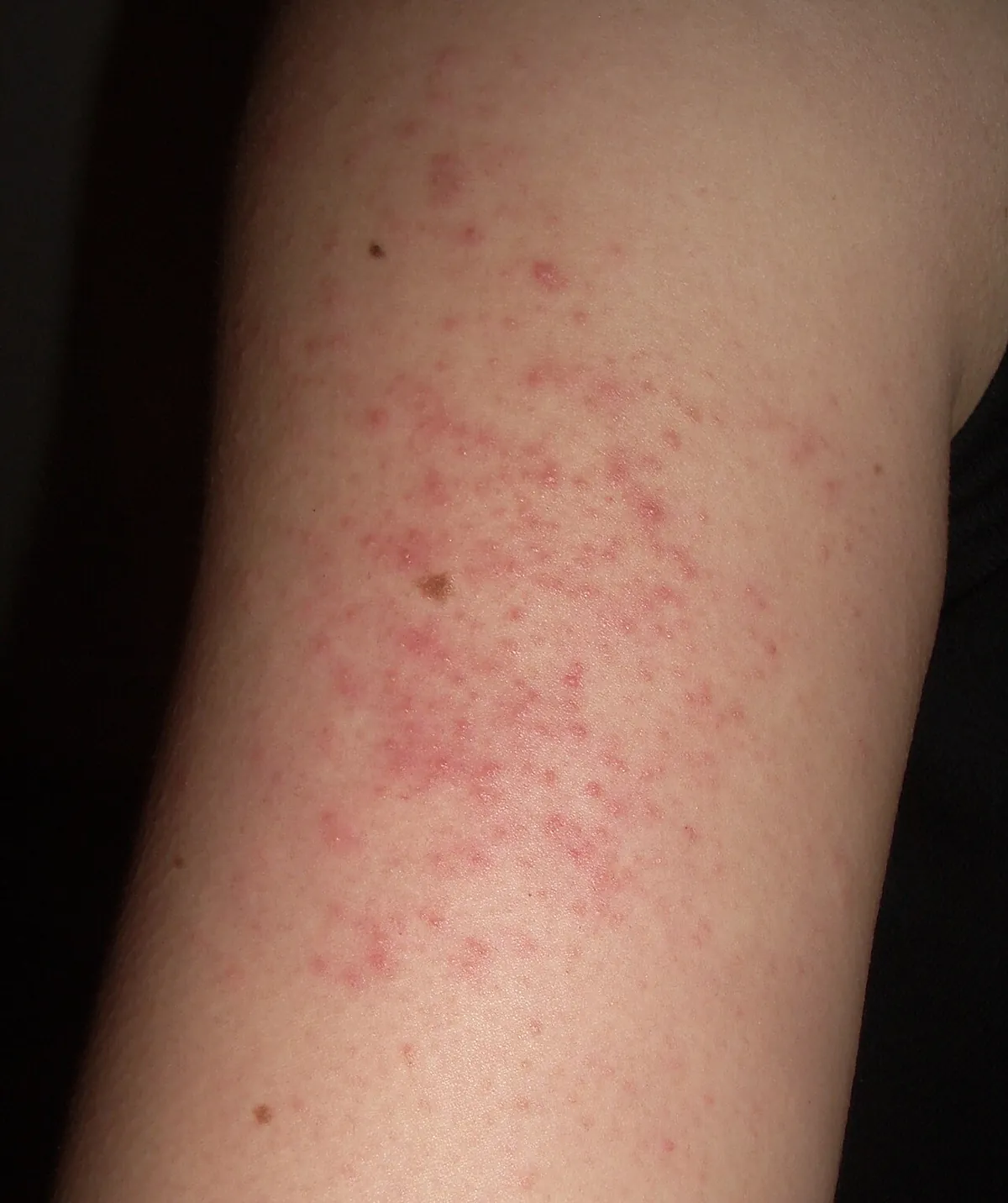
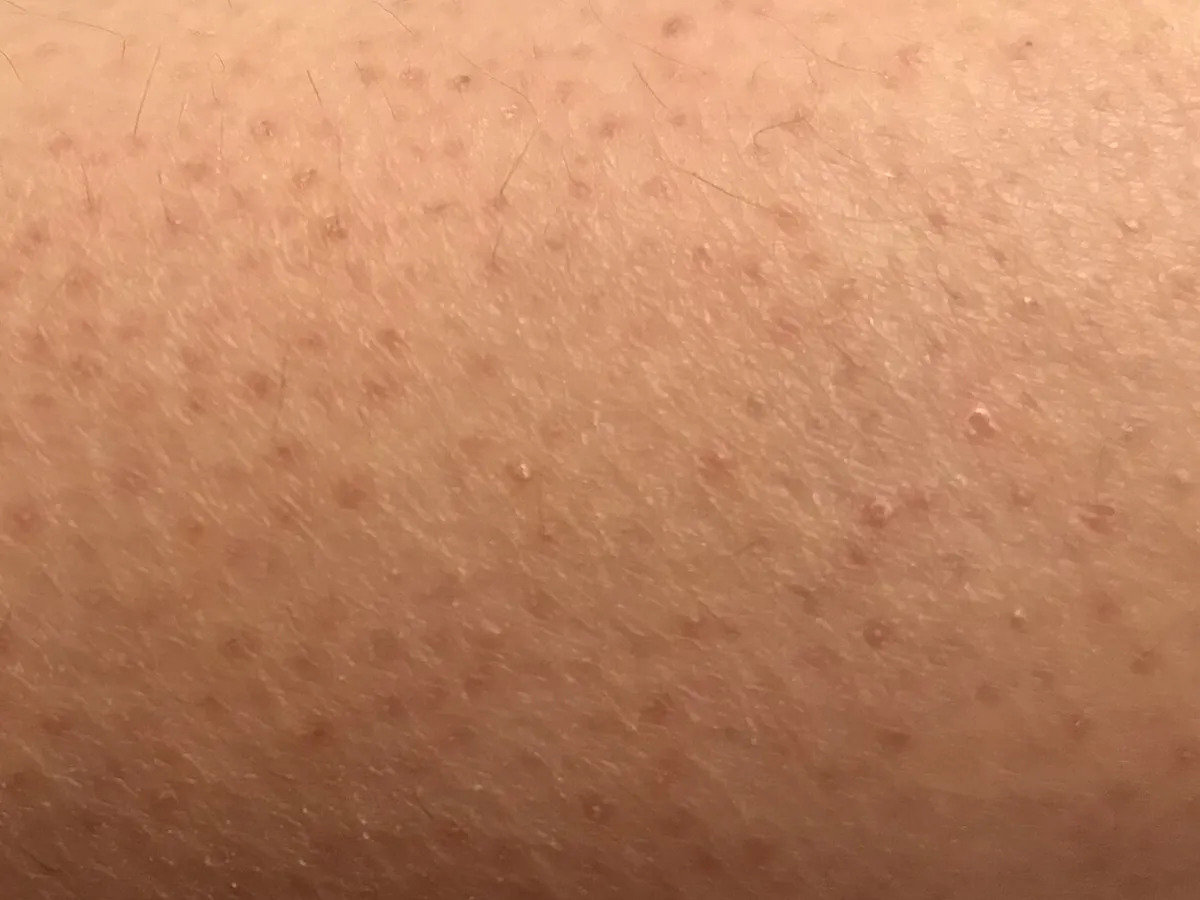
KP looks like many tiny bumps, each centered on a hair follicle, spread evenly across an area. The skin feels like sandpaper. The American Academy of Dermatology (AAD) notes some people compare the bumps to goosebumps and others mistake them for pimples. They are actually plugs of dead skin cells. Some bumps have a tiny coiled hair trapped inside. KP usually doesn't hurt, though it can itch, especially when the skin is dry.
How KP looks on different skin tones
The NHS says the bumps are usually skin-colored, and "can also be red if they're on white skin, or darker on brown or black skin". DermNet describes them as brown or black on darker skin. On lighter skin, a pink or red ring around each bump is common. On brown and black skin, picking or scrubbing hard can leave dark marks that last longer than the bumps, so a gentle approach matters even more.
Where on the body does it appear?
- Upper arms: the back and outer side are the classic spot.
- Thighs: mostly the front.
- Buttocks, which the NHS lists along with the arms and thighs.
- Cheeks: the AAD notes that children may have the bumps on their cheeks.
- Less often the forearms, back, lower legs and eyebrows.
What is keratosis pilaris on the face (KP rubra faceii)?
On the face, KP usually shows up as fine rough bumps on the outer cheeks, sometimes with redness across the skin around them. Several related forms affect the face:
- Keratosis pilaris rubra: a form with marked redness around the follicles. A case series in Archives of Dermatology called it "a common but underrecognized condition" and found it most often on the outer cheeks and the upper arms and legs.
- Erythromelanosis follicularis faciei et colli: DermNet describes this form as redness and brown pigmentation with bumps on the cheeks, sometimes extending to the neck.
- Ulerythema ophryogenes: KP-like bumps and redness on the outer eyebrows, which can thin the brow hair.
"KP rubra faceii" is the informal name many people search for when they have rough, red cheeks with tiny bumps. Because facial KP is easily mistaken for acne or rosacea, a dermatologist should confirm it before you treat it with strong acids or acne products.
What causes keratosis pilaris, and who gets it?
KP happens when keratin, the protein that forms the skin's surface, builds up and plugs hair follicles. Why it happens isn't fully known. The NHS says it is thought to run in families, and DermNet links it to changes in filaggrin, a protein important for the skin barrier.
It is very common. DermNet says it affects 50 to 70% of teenagers and 40% of adults, and it becomes more noticeable in the teen years. It is linked with atopic eczema and with ichthyosis, a group of very dry skin conditions.
Dry skin makes it more visible. The AAD says bumps often improve in summer and return in winter, and that people in dry climates or who swim often in pools may have them year-round. The NHS says many people have it for years and it may eventually clear on its own.
It is not contagious. The NHS says it isn't infectious and can't be passed on.
Is it keratosis pilaris or something else?
| Condition | How it differs from KP |
|---|---|
| Acne | Mixed blackheads, whiteheads, red bumps and pus spots of different sizes; oily areas; KP bumps are tiny, uniform and rough |
| Fungal acne (Malassezia folliculitis) | Itchy, uniform small pimples on chest, back and forehead, often after sweating |
| Razor bumps | Appear in shaved areas after shaving; tender, with ingrown hairs |
| Closed comedones | Smooth skin-colored bumps on forehead and chin; not rough to the touch |
| Rosacea | Flushing and redness in the center of the face; bumps aren't rough |
| Milia | Hard, white, pearl-like dots, usually around the eyes, not in a sandpaper spread |
How do you get rid of keratosis pilaris?
There's no cure, but you can make it much smoother. The AAD notes that "Clearing takes time": if you see no improvement after 4 to 6 weeks, tell your dermatologist. Once it improves, you need a maintenance routine, or the bumps come back.
Moisturize on a schedule
Moisturizing is the base of KP care. The AAD recommends a moisturizer with urea or lactic acid, applied within 5 minutes of a shower or bath while the skin is still damp, and massaged in at least 2 to 3 times a day. Both ingredients hydrate and loosen the plugs. Read more in our guides to urea cream and lactic acid for dry skin.
For arms and legs, body lotions built for rough skin are a practical choice. Eucerin Roughness Relief Lotion, for example, lists 10% urea and is fragrance-free; 12% lactic acid lotions such as AmLactin Daily are another common drugstore option. These are body products, so keep them off the face unless a doctor says otherwise. Products with acids can make skin more sensitive to the sun, so use sunscreen on treated areas that see daylight.
Exfoliate gently
The AAD suggests gentle exfoliation with a loofah or a mild scrub. Harsh scrubbing makes KP redder and can leave dark marks. Chemical exfoliants are often easier on the skin: salicylic acid loosens plugs inside the follicle, and lactic acid smooths the surface. Our guide to physical vs chemical exfoliants and AHA vs BHA explains the difference.
A salicylic acid wash, a lactic acid leave-on and a rich ceramide cream cover the basics. CeraVe's US Renewing SA Cleanser is labeled for face and body; The Ordinary Lactic Acid 10% + HA is a face product, so on cheeks start a few nights a week and stop if it stings. You can scan a product's barcode or label with the ingredient scanner in Pori to check it against your skin type before you buy.
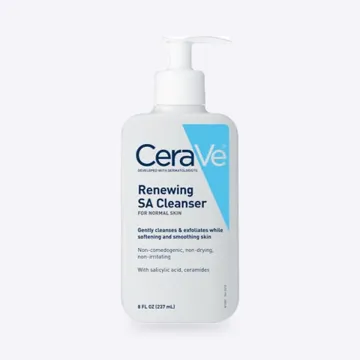
Renewing SA Cleanser
Face cleanser with niacinamide, gluconolactone and salicylic acid. Fragrance-free.
Suits: Normal, Oily, Combination, Sensitive skin
Lactic Acid 10% + HA
Leave-on exfoliant with lactic acid, hyaluronic acid and glycerin. Fragrance-free.
Suits: Normal, Dry, Oily, Combination skin
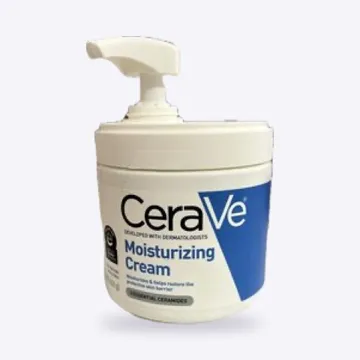
Moisturizing Cream
Thick ceramide cream for skin that dries out by midday.
Suits: Dry, Normal, Sensitive skin
From Pori's catalogue. Amazon links carry our Associates tag: Pori earns from qualifying purchases, at no cost to you. No brand pays to be listed. Photos: Open Beauty Facts contributors, CC BY-SA 3.0.
Don't stack several acids at once. The AAD advises stopping for a few days if your skin becomes dry or irritated. For more on pacing, see how often to exfoliate your face.
How to treat KP on the face
Facial skin is thinner and more reactive than the skin on your arms, so go slower. Use face products, not body lotions with 10% urea or 12% lactic acid. Start one exfoliating product at a time, two or three nights a week, and pair it with a plain, fragrance-free moisturizer. Wear sunscreen every morning, since acids can make skin more sensitive to the sun and redness can deepen with sunburn. Skip gritty scrubs and drying acne spot treatments on red cheeks, which tend to add irritation. If the cheeks stay red after several weeks of gentle care, that redness is what lasers and light treatments target, and a dermatologist can tell you whether they suit your skin tone.
Simple habits that help
- Take short showers in lukewarm water; the NHS suggests cool or lukewarm water and mild, unperfumed soap.
- Don't pick or squeeze the bumps.
- Choose fragrance-free products if your skin is easily irritated or you also have eczema.
What a dermatologist may offer
If home care doesn't help, the AAD lists prescription exfoliants that may contain a retinoid (such as tretinoin, tazarotene or adapalene), higher-strength AHAs, salicylic acid or urea. A short course of a corticosteroid cream may be used to calm inflamed, itchy bumps. For persistent redness, especially on the cheeks, laser or light treatments can reduce redness and improve texture. These don't cure KP either, so maintenance continues afterward.
When should you see a doctor about keratosis pilaris?
KP is harmless, so many people never need a doctor. See a dermatologist if:
- You're not sure the bumps are KP, especially on the face
- The bumps are very itchy, painful or inflamed
- Bumps turn into pus-filled spots, crust or ooze, which can mean infection
- Redness on the cheeks is spreading or bothers you
- Four to six weeks of regular care hasn't helped
- Bumps have left dark marks or scars
When you're ready, you can find a dermatologist near you.
Frequently asked questions
What is keratosis pilaris?
Keratosis pilaris is a common, harmless condition in which plugs of dead skin cells form in hair follicles. It causes small, rough bumps, most often on the backs of the upper arms and the fronts of the thighs.
Can you get keratosis pilaris on your face?
Yes. Children often get it on the cheeks, and some people have keratosis pilaris rubra, which adds redness around the bumps on the outer cheeks. A dermatologist should confirm facial KP, since acne and rosacea can look similar.
Is keratosis pilaris contagious?
No. KP isn't an infection and can't be passed from person to person. It tends to run in families.
What is the best treatment for keratosis pilaris?
The American Academy of Dermatology recommends moisturizers with urea or lactic acid, applied within 5 minutes after bathing and at least 2 to 3 times a day, plus gentle exfoliation. If there is no improvement after 4 to 6 weeks, a dermatologist can prescribe stronger options.
Does keratosis pilaris go away?
It can't be cured, but it often improves in summer and with regular care. The NHS notes many people have it for years and it may eventually clear on its own.
Should I scrub keratosis pilaris?
Only gently. Hard scrubbing can make the bumps redder and leave dark marks, especially on brown and black skin. A soft loofah or a chemical exfoliant such as salicylic or lactic acid is usually better.
Sources
- American Academy of Dermatology: Keratosis pilaris: Overview
- American Academy of Dermatology: Keratosis pilaris: Diagnosis and treatment
- NHS: Keratosis pilaris
- DermNet: Keratosis pilaris
- Marqueling AL et al. Keratosis pilaris rubra: a common but underrecognized condition. Arch Dermatol, 2006 (PubMed)
- Eucerin US: Roughness Relief Lotion
- CeraVe US: Renewing SA Cleanser
Pori is a wellness and skincare education app, not a medical device. This article is for general information and isn't medical advice. For anything that worries you, see a dermatologist.