Pori

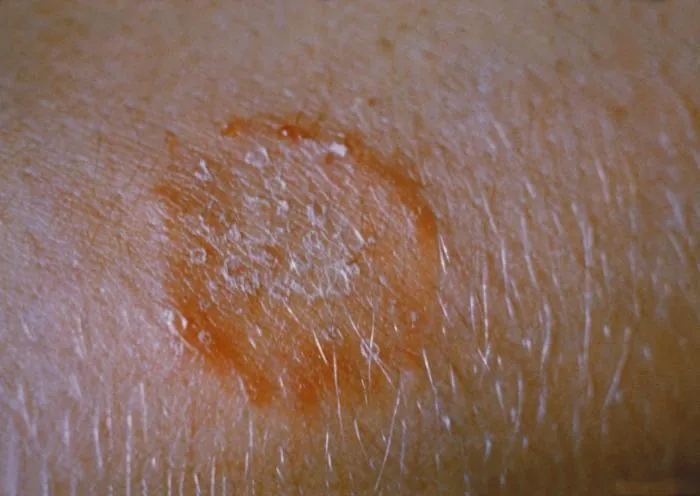
- Ringworm on the face (tinea faciei) is a fungal infection that causes round or oval, itchy patches with a raised, scaly edge and a clearer center, often on one side of the face.
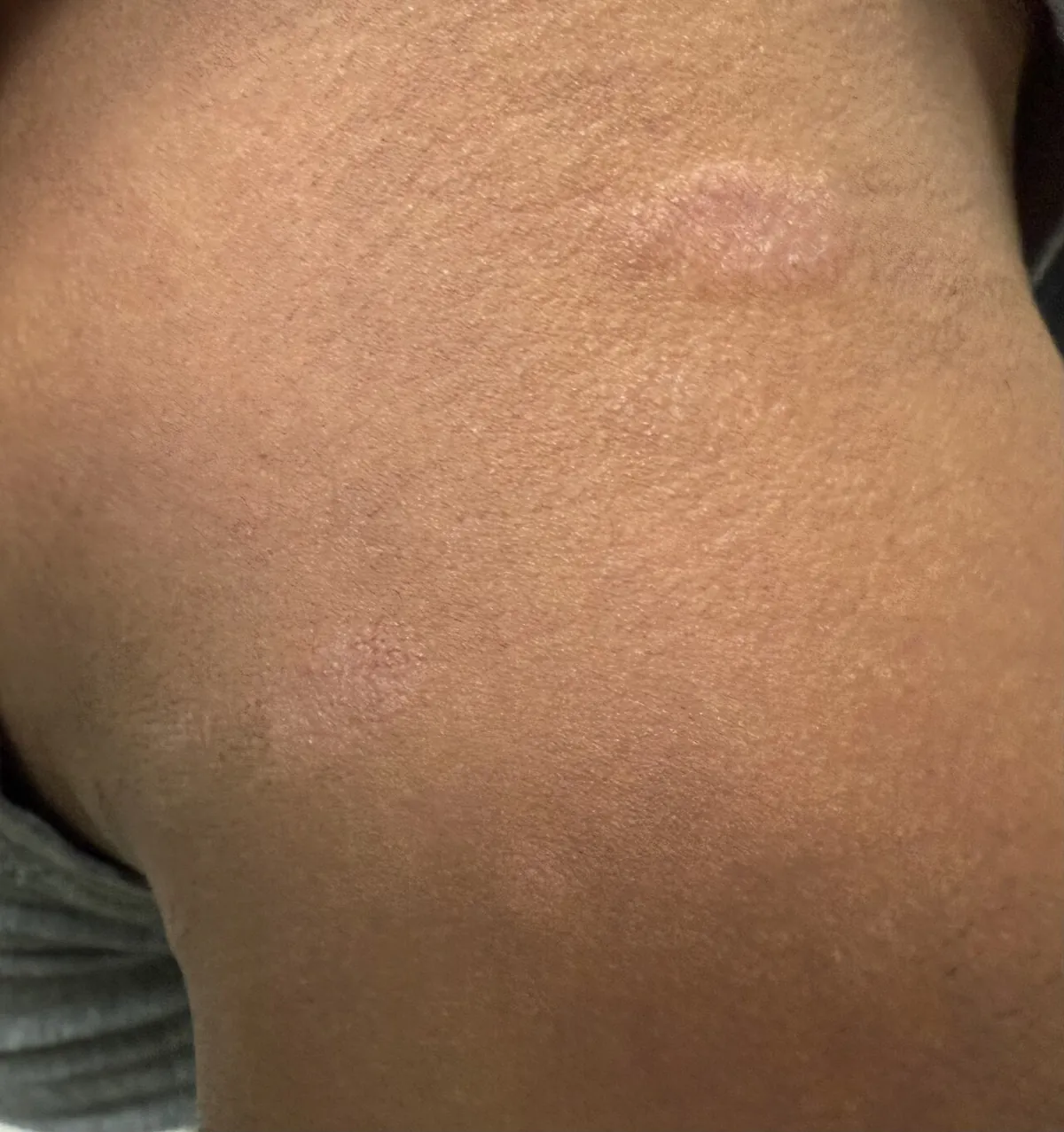
- It looks red on light skin and gray, brown or darker on brown and black skin; you can catch it from pets, other people, shared towels or your own athlete's foot.
- It is often mistaken for eczema, rosacea or dermatitis; steroid creams such as hydrocortisone can make it spread and look atypical (tinea incognito).
- OTC antifungals such as clotrimazole or terbinafine usually clear it over 1 to 4 weeks; beard-area, widespread or stubborn cases need a doctor and sometimes oral medicine.
Ringworm on the face, called tinea faciei, is a fungal skin infection that usually shows up as a round or oval, itchy patch with a raised, scaly edge and a clearer center, often on one side of the face. It looks red on light skin and gray, brown or darker on brown and black skin. It is often mistaken for eczema or rosacea and treated with a steroid cream, which can make it spread and look less like a ring; an antifungal cream is what clears it.
Pori does not diagnose skin conditions; its selfie scans and photo diary in Pori can help you keep dated, consistent photos to show a dermatologist and see whether treatment is working.
This guide covers what tinea faciei looks like, how you catch it, why it is so often misdiagnosed, and how to treat it safely on facial skin.
What does ringworm on the face look like?
Despite the name, ringworm has nothing to do with worms. The CDC says it is a common fungal infection that causes an itchy, scaly rash that is often ring-shaped. DermNet describes tinea faciei as round or oval red, scaly patches that are often asymmetric and frequently on one side of the face, with a center that may look less red and scaly or even healed.
- Shape: a ring or arc with a raised, scaly border that slowly spreads outward.
- Number: one patch or a few; they can merge into larger shapes.
- Feel: often itchy, sometimes burning.
- Sun: DermNet notes that sun exposure often makes it worse, which can make it look like a sun-sensitive rash.
How ringworm looks on brown and black skin
The CDC says the rash looks red on light skin and gray or brown on darker skin, and the AAD says that on skin of color the patches are usually brown or gray rather than red or pink. Redness is easy to miss on darker skin, so look for the raised, scaly edge and the clearer center.
Ringworm in the beard area
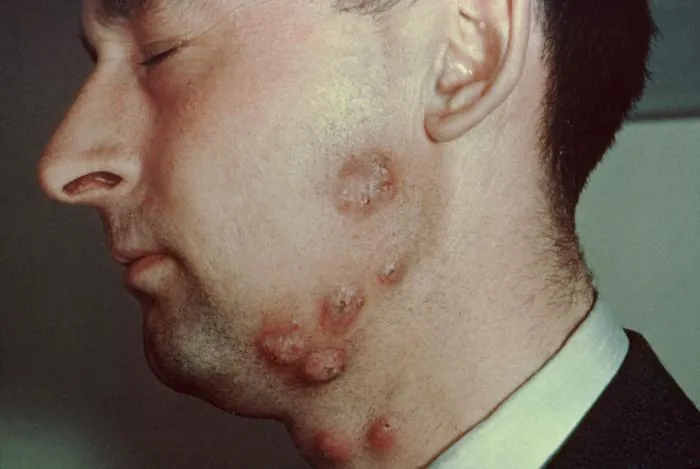
Ringworm in the beard and moustache area has its own name, tinea barbae, and DermNet counts it separately from tinea faciei. The AAD describes intense redness and swelling, pus-filled bumps, hair loss and raw skin on the bearded area of the face and neck, and notes it can look like acne or folliculitis. Most men get it from contact with an infected animal, and farmers and ranchers get it more often. It needs prescription antifungal medicine.
How do you get ringworm on your face?
The fungi that cause ringworm live on people, animals and surfaces. The CDC lists:
- Skin-to-skin contact with a person or animal that has it;
- Shared items such as towels and bedsheets;
- Shared surfaces such as locker room and public bathroom floors.
For the face, pets and your own body are common sources. DermNet notes that tinea faciei often spreads from the feet or nails, so athlete's foot or a fungal nail infection can be the origin. Animal fungi come from cats and dogs, and from farm cattle. Cuddling a pet with patchy hair loss, or touching your face after scratching your feet, can carry it to your face. Contact sports such as wrestling raise the risk too, the CDC notes.
Children get it often. A 30-year study of 73 children with tinea faciei in southern Spain found that 46.6% were aged 4 to 9, and the authors concluded it must be considered in children with inflammatory facial rashes.
Why is ringworm on the face so often misdiagnosed?
On the face, ringworm often does not look like a textbook ring. The patch can be less scaly than ringworm elsewhere, and it can look like eczema or rosacea. DermNet lists the conditions it is commonly mistaken for: eczema, seborrheic dermatitis, psoriasis, rosacea, actinic keratoses, allergic contact dermatitis, perioral dermatitis, cutaneous lupus and polymorphous light eruption.
Why steroid creams make it worse
Steroid creams, including over-the-counter hydrocortisone, calm inflammation, so a fungal rash may look better for a while. They do not kill the fungus, though, so it keeps growing, and the rash can spread and look less like a ring. DermNet notes that steroids can mask the infection; this altered form is called tinea incognito. The CDC warns against using steroid creams on a rash that could be ringworm, because they can make the infection worse.
This is common. In the Spanish study, 29.2% of children with tinea faciei had already been treated with topical steroids by the time they were diagnosed. A Tunisian series of 14 patients found 4 cases of tinea incognito caused by steroid creams. If a face rash gets better with a steroid cream and then comes back bigger when you stop, tell your doctor.
Is it ringworm or something else?
| Condition | How it differs from ringworm |
|---|---|
| Eczema | Dry, itchy patches without a sharp, raised ring edge; often on both sides; history of flares |
| Seborrheic dermatitis | Greasy, yellowish flakes along the eyebrows, sides of the nose and scalp |
| Psoriasis | Thick, well-defined plaques with silvery scale, usually with patches elsewhere |
| Rosacea | Redness and flushing across the center of the face, often with bumps; no scaly ring |
| Perioral dermatitis | Tiny bumps around the mouth and nose, with a clear band next to the lips |
| Contact dermatitis | Itchy rash where a product or substance touched; clears when the trigger is removed |
| Tinea versicolor | A different yeast; many flat, lighter or darker spots on the chest, back and neck, rarely the face |
A doctor can confirm ringworm by scraping a little scale from the edge and checking it under a microscope or sending it for culture or PCR, as DermNet describes. Seeing the fungus is the only way to be sure, and it is worth doing before a long course of treatment. For other causes, see our guide to rashes on the face.
How do you treat ringworm on the face?
Most skin ringworm clears with an antifungal cream. The AAD says most of these medicines you apply twice a day for two to four weeks, that the scale clears before the redness, and that stopping early may fail to clear the infection.
Over-the-counter antifungal creams
- Clotrimazole 1%: a typical OTC label for ringworm directs a thin layer twice daily for 4 weeks, and says to ask a doctor if there is no improvement within 4 weeks. It is not for children under 2 unless a doctor directs.
- Terbinafine 1% (Lamisil AT): the label directs once a day for 1 week for ringworm in adults and children 12 and older, and says not to use it in or near the mouth or eyes.
Tips for using them on the face:
- Wash and dry the area, then apply a thin layer over the whole patch, as the labels direct.
- Keep creams away from the eyes and mouth. For a patch near the eye or lips, ask a pharmacist or doctor first.
- Do not use hydrocortisone or other steroid creams on the patch, even for itch, unless a doctor has confirmed the diagnosis and told you to.
- Use a gentle cleanser and a plain, fragrance-free moisturizer away from the patch, and skip exfoliating acids and retinoids on that area until it heals.
- Use your own towel and wash pillowcases often while it heals.
When you need prescription treatment
The AAD says large areas of skin may need a prescription antifungal medicine, and that ringworm in the beard area and on the scalp needs prescription medicine. DermNet notes that if creams fail, oral antifungals such as terbinafine or itraconazole may be considered, and that resistance to antifungal drugs is making treatment harder in some cases. If you suspect a pet is the source, have a vet check it, since the CDC lists infected animals as a way ringworm spreads.
When should you see a doctor about ringworm on the face?
See a doctor or find a dermatologist if:
- the rash does not improve within 4 weeks of using an OTC antifungal as the label directs;
- it is in the beard area, on the scalp, or near the eye;
- it is swollen, boggy, oozing or full of pus bumps, or you have fever;
- it spread or changed after you used a steroid cream;
- a child under 2 has the rash;
- you have diabetes or a weakened immune system;
- you are not sure it is ringworm. Several look-alikes on the face need very different treatment.
Photos of the patch every few days during treatment show whether the edge is shrinking or still spreading, which is useful to share at an appointment.
Frequently asked questions
What does ringworm on the face look like?
A round or oval itchy patch with a raised, scaly border and a clearer center, often on one side of the face. It looks red or pink on light skin and gray, brown or darker on brown and black skin.
Can I put hydrocortisone on ringworm on my face?
No. The CDC warns against using steroid creams on a rash that could be ringworm, because they can make it worse. Steroids can make the rash spread and lose its ring shape, a form called tinea incognito.
What is the best cream for ringworm on the face?
OTC antifungals such as clotrimazole 1% or terbinafine 1% usually work. Follow the label, keep them away from the eyes and mouth, and see a doctor if there is no improvement within 4 weeks.
How long does ringworm on the face take to go away?
With an antifungal cream, the AAD says most skin ringworm clears with twice-daily use over two to four weeks. Keep using it for the full course, since stopping early can let the infection return.
Is ringworm on the face contagious?
Yes. It spreads by skin contact with people or animals, and through shared towels and bedding. Wash your hands after touching the patch, use your own towel and have pets with patchy fur checked by a vet.
How do I know if it is ringworm or eczema?
Ringworm usually has a sharp, raised, scaly ring edge, is often on one side, and slowly spreads outward. Eczema is less well defined and often on both sides. A doctor can confirm ringworm with a quick skin scraping.
Sources
- CDC: About Ringworm
- American Academy of Dermatology: Ringworm: Signs and symptoms
- American Academy of Dermatology: Ringworm: Diagnosis and treatment
- DermNet: Tinea faciei
- del Boz J et al. Pediatric tinea faciei in southern Spain: a 30-year survey. Pediatr Dermatol, 2012 (PubMed)
- Belhadjali H et al. Tinea faciei, underrecognized because clinically misleading: 14 cases. Presse Med, 2009 (PubMed)
- DailyMed: Antifungal clotrimazole 1% cream label
- DailyMed: Lamisil AT (terbinafine hydrochloride) cream label
Pori is a wellness and skincare education app, not a medical device. This article is for general information and isn't medical advice. For anything that worries you, see a dermatologist.