Pori

- From gentlest to strongest: retinyl esters, retinol, retinal, adapalene, then prescription tretinoin, tazarotene and trifarotene.
- Each conversion step to retinoic acid makes a retinoid gentler and weaker; retinol is about 10 to 20 times less potent than tretinoin.
- Adapalene 0.1% has been sold over the counter for acne since 2016 and is the mildest drug retinoid.
- Skip retinoids in pregnancy; tazarotene and isotretinoin can cause serious birth defects.
The main types of retinoids, from gentlest to strongest, are retinyl esters (such as retinyl palmitate), retinol, retinal (retinaldehyde), over-the-counter adapalene, and the prescription retinoids tretinoin, tazarotene and trifarotene. The weaker forms have to be converted in the skin into retinoic acid, the form that does the work, and every conversion step makes them gentler and less potent. Start low on the ladder, move up only when your skin tolerates it, and skip retinoids during pregnancy.
If you're unsure what a product actually contains, you can scan its barcode or label with the ingredient scanner in Pori to see which retinoid is on the list and check the formula against your skin type. It reads the ingredients; it doesn't diagnose skin conditions.
Below is the full strength ladder in one table, what each rung does, how irritating it tends to be, what to do in pregnancy, and how to move up safely. This guide is based on dermatology guidance, published reviews and FDA records. If you only want the two most common over-the-counter options compared, read retinal vs. retinol; if you're about to start, retinol for beginners walks through the first weeks.
What are retinoids?
Retinoids are vitamin A and the compounds made from it. The American Academy of Dermatology (AAD) calls the word a catch-all for an array of vitamin A-based products used on skin. They speed up cell turnover, which is why they help with acne, fine lines, rough texture and uneven tone.
The key idea is conversion. A 2022 review in Advances in Therapy explains that retinyl esters are broken down to retinol, and retinol is converted to retinoic acid (tretinoin) through retinaldehyde in a two-step oxidation. Tretinoin is already the active form. Synthetic retinoids such as adapalene, tazarotene and trifarotene are active as they are and don't need converting. So, roughly, the more steps a retinoid needs, the gentler and weaker it is.
What is the retinoid strength ladder?
| Retinoid (label name) | Where you get it | Steps to the active form | Typical use | Irritation |
|---|---|---|---|---|
| Retinyl esters (retinyl palmitate, acetate, propionate) | Over the counter | Three | Cosmetic anti-aging creams | Low |
| Retinol | Over the counter | Two | Fine lines, texture, tone | Low |
| Retinal (retinaldehyde) | Over the counter | One | Fine lines, texture | Low |
| Adapalene 0.1% | Over the counter (Differin Gel) | None | Acne, ages 12 and up | Mildest of the drug retinoids |
| Tretinoin | Prescription | None | Acne, photoaging | Highest |
| Tazarotene | Prescription | None | Acne, psoriasis, photoaging | High |
| Trifarotene | Prescription | None | Acne, ages 9 and up | Few comparisons yet |
Two caveats. Strength also depends on the percentage and the base, so a high-strength retinol can feel harsher than a gentle prescription cream. And the irritation column is a general pattern from the reviews below, not a rule for every product.
Retinyl esters
Retinyl palmitate, retinyl acetate and retinyl propionate are the most stable and the weakest. The 2022 review says retinyl palmitate is widely used as a stable alternative to retinol, yet its use as an antiaging agent is not supported by clinical evidence, and the other esters lack strong trials too. A cream that lists retinyl palmitate far down the list is unlikely to change your skin much. That can be fine if you only want a very gentle first step.
Retinol
Retinol is the most familiar over-the-counter retinoid and the most studied in cosmetics. It's weaker than the prescription drugs: one review puts it at 20 times less potent than tretinoin, and the newer review estimates about tenfold less potent. Cleveland Clinic calls it the weakest option, sold over the counter in serums and creams. The AAD notes that over-the-counter retinol labels don't have to state the percentage, so it suggests choosing the least-intense formula you can find to start.
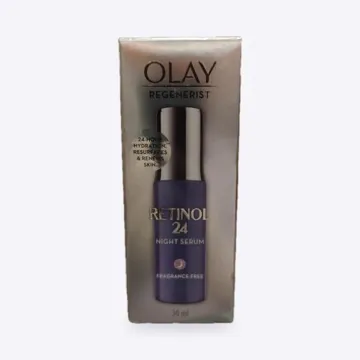
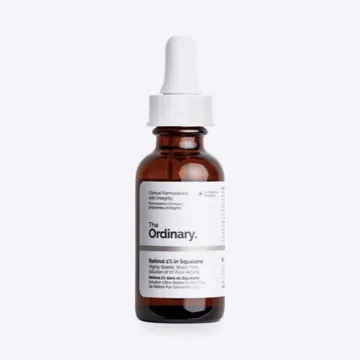
CeraVe Resurfacing Retinol Serum and Olay Regenerist Retinol24 Night Serum are fragrance-free starters. The Ordinary Retinol 1% in Squalane is a stronger step for later.
Resurfacing Retinol Serum
Buffered retinol aimed at post-acne marks and rough texture.
Suits: Oily, Combination, Normal skin
Regenerist Retinol24 Night Serum
Overnight retinol with the moisture cushion built in.
Suits: Normal, Dry, Combination skin
Retinol 1% in Squalane
Evening serum with retinol and squalane. Fragrance-free.
Suits: Normal, Dry, Oily, Combination skin
From Pori's catalogue. Amazon links carry our Associates tag: Pori earns from qualifying purchases, at no cost to you. No brand pays to be listed. Photos: Open Beauty Facts contributors, CC BY-SA 3.0.
Retinal (retinaldehyde)
Retinal sits one step from retinoic acid. The 2022 review calls it the most effective retinoid in cosmeceuticals because of its balance of activity and tolerance, and explains that skin turns only a small fraction of it into tretinoin, which helps keep irritation low. It is harder to keep stable, so packaging matters. Our retinal vs. retinol comparison covers when to switch.
Newer cosmetic retinoids: HPR and retinyl retinoate
Some products use retinoids that don't fit neatly on the chain. Hydroxypinacolone retinoate (HPR), sold as Granactive Retinoid, is an ester of retinoic acid that brands describe as gentle; published human data on it alone are thin, as our Granactive Retinoid review explains. Retinyl retinoate was made by joining retinol and retinoic acid, and the 2022 review says it is considered more stable and less irritating than older derivatives. Treat both as gentle options with less evidence than retinol.
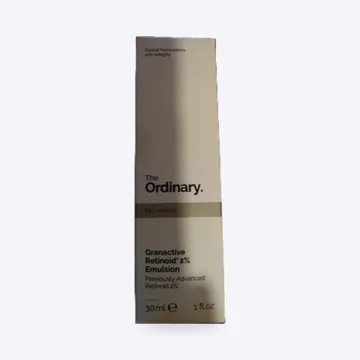
Granactive Retinoid 2% Emulsion
Retinoid for fine lines that irritates less than classic retinol.
Suits: Normal, Dry, Combination, Oily skin
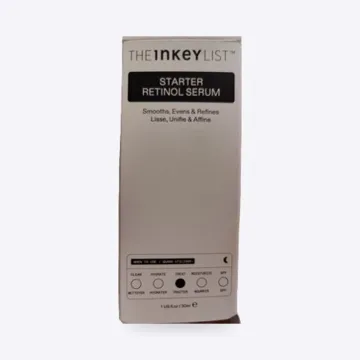
Starter retinol serum
Evening serum with retinal, hydroxypinacolone retinoate and glycerin. Fragrance-free.
Suits: Normal, Dry, Oily, Combination skin
From Pori's catalogue. Amazon links carry our Associates tag: Pori earns from qualifying purchases, at no cost to you. No brand pays to be listed. Photos: Open Beauty Facts contributors, CC BY-SA 3.0.
Adapalene (over the counter)
Adapalene is a synthetic retinoid built for acne. The FDA approved Differin Gel 0.1% for over-the-counter use on July 8, 2016, and an FDA summary called it the first retinoid to be made available OTC for the treatment of acne, for people 12 and older. In May 2026 the FDA also moved Differin Epiduo Acne Gel, which pairs adapalene 0.1% with benzoyl peroxide 2.5%, to over-the-counter sale. DermNet NZ calls adapalene the least irritating topical retinoid. See our adapalene guide for how to start it.
Tretinoin (prescription)
Tretinoin is retinoic acid itself. The AAD says it was FDA-approved as a topical acne treatment in 1971 and also improves fine lines and wrinkles. The 2022 review calls it the most potent and best studied retinoid for aging skin, with strengths from 0.01% to 0.1%, most often 0.025%, 0.05% or 0.1%. DermNet ranks it the most irritating topical retinoid, so dryness and peeling in the first weeks are common. Our tretinoin guide covers the first months.
Tazarotene (prescription)
Tazarotene is a third-generation retinoid used for acne and psoriasis. In a 24-week trial of 568 people with sun-damaged skin, a 0.1% tazarotene cream reduced fine wrinkles, mottled pigmentation and roughness more than the base cream. One review notes that irritation is more prominent with tretinoin and tazarotene than with retinal and retinol. Tazarotene also carries the clearest pregnancy warning of the topicals (see below).
Trifarotene (prescription)
Trifarotene is the newest. A drug profile in the journal Drugs describes it as a first-in-class, fourth-generation retinoid that targets one retinoid receptor (RAR-gamma), approved in the US in October 2019 for acne in people 9 and older. DermNet notes it is highly specific for the skin retinoid receptor. The 2022 review found no head-to-head study yet showing it beats older retinoids for aging skin.
Isotretinoin is a separate case: it's an oral prescription drug for severe acne, prescribed and monitored by a dermatologist.
Which retinoid is the most irritating?
Irritation, sometimes called retinoid dermatitis, shows up as redness, dryness, peeling and stinging. DermNet lists it alongside sun sensitivity and, rarely, allergic contact dermatitis. As a pattern, the prescription retinoids tretinoin and tazarotene irritate most, retinal and retinol are considerably less irritating, and adapalene is the mildest of the drug retinoids. The base matters too: DermNet notes that creams are the least irritating formulation and gels the least noticeable on skin.
The AAD adds a point for darker skin tones: irritation can lead to dark marks, and starting slowly and using moisturizer lowers that risk. If you're already flaking, see peeling from retinol, and use purging vs. breakout to tell early retinoid purging from a reaction.
Can you use retinoids while pregnant?
The short answer is no. The AAD says plainly that retinoids should not be used during pregnancy. Its acne-in-pregnancy page lists isotretinoin and tazarotene among medicines to never take while pregnant because they can cause serious birth defects, and says most experts recommend stopping adapalene and tretinoin. DermNet notes that tazarotene is pregnancy category X in the US.
Over-the-counter forms are a gray zone. When it approved Differin Gel for OTC use, the FDA found no evidence that it causes birth defects given its limited absorption, but still told people who are pregnant, planning a pregnancy or breastfeeding to ask a doctor first. Cleveland Clinic says providers generally discourage retinoids, including retinol, during pregnancy. The 2022 review reached the same practical conclusion: topical retinoids in pregnancy cannot be advised.
If you're pregnant or trying, the AAD describes azelaic acid as thought to be safe to use during pregnancy. Our pregnancy-safe skincare routine and bakuchiol vs. retinol cover other options; check each one with your obstetrician.
How do you choose a retinoid and move up the ladder?
- Pick by goal. For acne, adapalene is the logical over-the-counter start. For fine lines and texture, start with a low-strength retinol or a gentle retinal.
- Start low and slow. The AAD suggests the least-intense formula every other night to start, slowly building up. Cleveland Clinic suggests a patch test first and alternate days for the first couple of weeks.
- Use it at night, with sunscreen by day. Retinoids make skin more sun-sensitive, which is why the AAD advises using them only at night.
- Give each step months. DermNet says acne can take 12 weeks or longer to improve on a retinoid. Move up only when your current product causes no irritation and you want more.
- Change one thing at a time. Going from retinol to retinal, or raising the percentage, is one step. Adding an acid the same week is two.
- See a dermatologist for prescription strength. Tretinoin, tazarotene and trifarotene need a prescription; our dermatologist directory can help you find one.
Pair any retinoid with a plain, fragrance-free moisturizer; our moisturizers for tretinoin users work for the over-the-counter rungs too. For a comparison of ready-made serums, see the best retinol serums for beginners, and for how retinoids fit beside other serums, types of serums.
Frequently asked questions
What are the main types of retinoids?
From gentlest to strongest: retinyl esters such as retinyl palmitate, retinol, retinal (retinaldehyde), over-the-counter adapalene, and the prescription retinoids tretinoin, tazarotene and trifarotene. Isotretinoin is an oral prescription drug for severe acne.
Which retinoid is strongest?
Among topicals, the prescription retinoids are strongest. Tretinoin is the most potent and best studied for aging skin, and tazarotene is similarly strong and irritating. Retinol is estimated to be about 10 to 20 times less potent than tretinoin.
Is retinal stronger than retinol?
Yes. Retinal is one conversion step closer to retinoic acid than retinol, and a 2022 review calls it the most effective retinoid in cosmetics. Skin converts only a small share of it to retinoic acid, which helps keep irritation low.
Is adapalene a retinoid?
Yes. Adapalene is a synthetic retinoid. Differin Gel 0.1% became the first retinoid sold over the counter for acne in the US in 2016, for people 12 and older, and it is considered the least irritating of the topical drug retinoids.
Can I use retinol while pregnant?
Dermatologists advise against it. The AAD says retinoids should not be used during pregnancy, and tazarotene and isotretinoin can cause serious birth defects. Ask your obstetrician about alternatives such as azelaic acid.
How do I move up from retinol to a stronger retinoid?
Use your current product nightly without irritation for a few months first. Then change one thing: a higher retinol strength, a retinal product, or a prescription retinoid from a dermatologist. Keep using moisturizer and daily sunscreen.
Sources
- American Academy of Dermatology: Retinoid or retinol?
- American Academy of Dermatology: Acne treatment during pregnancy
- Milosheska D, Roškar R. Use of retinoids in topical antiaging treatments: a focused review of clinical evidence. Adv Ther, 2022 (PMC)
- Mukherjee S et al. Retinoids in the treatment of skin aging: an overview of clinical efficacy and safety. Clin Interv Aging, 2006 (PMC)
- U.S. Food and Drug Administration: Prescription to nonprescription switch list
- FDA (via AAP News): Topical retinoid acne treatment approved for OTC use, 2016
- DermNet: Topical retinoids
- Cleveland Clinic: Retinol: what it is, benefits and how to use
- Scott LJ. Trifarotene: first approval. Drugs, 2019 (PubMed)
Pori is a wellness and skincare education app, not a medical device. This article is for general information and isn't medical advice. For anything that worries you, see a dermatologist.