Pori

- Scabies is caused by mites that burrow into the skin, causing an intensely itchy, pimple-like rash that is typically worst at night.
- It favors the spaces between the fingers, wrists, elbows, armpits and waist; on brown and black skin, bumps can be harder to see but can still be felt.
- The CDC lists permethrin 5% cream and oral ivermectin as first-line treatments; everyone in the household and close contacts should be treated at the same time, even without symptoms.
- Wash bedding and clothes hot or bag them for 72 hours; itching can last 2 to 4 weeks after successful treatment, so new burrows matter more than itch alone.
A scabies rash is an intensely itchy rash of small, pimple-like bumps caused by tiny mites that burrow into the skin, and the itch is typically worst at night. It favors the spaces between the fingers, the wrists, elbows, armpits and waist, and you may see short, thread-like burrows. Scabies does not go away on its own: it needs a prescription treatment such as permethrin cream or ivermectin tablets, and everyone in close contact should be treated at the same time.
Pori does not diagnose skin conditions; its selfie scans and photo diary in Pori can help you keep dated, consistent photos to show a dermatologist and see whether treatment is working.
This guide covers what the rash looks like on different skin tones, how scabies spreads, what it is confused with, and how treatment works, following the CDC's guidance.
What does a scabies rash look like?
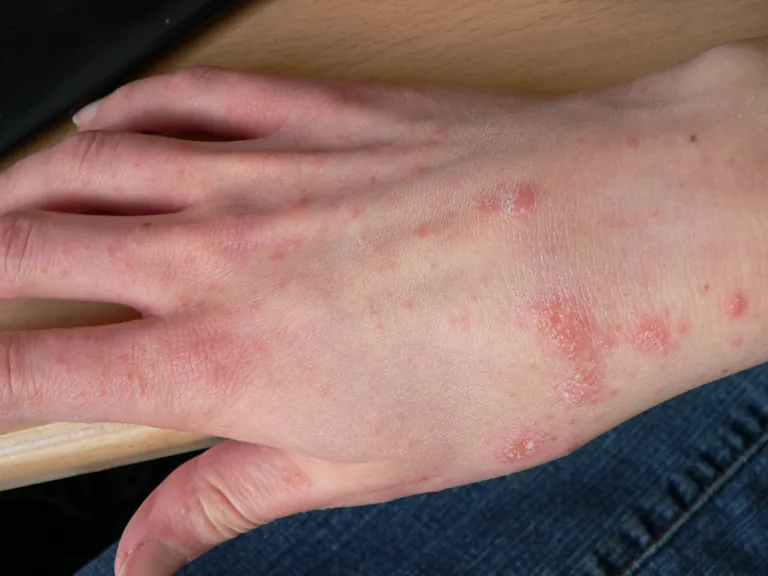
The CDC describes intense itching, often worse at night, and a pimple-like rash. The AAD says the bumps often form a line and can look like hives, tiny bites, knots under the skin or pimples. Some people get scaly patches that look like eczema.
- Bumps: small, raised and very itchy, often with scratch marks and scabs around them.
- Burrows: short, thin, wavy lines where a female mite tunnels under the skin. They are a key clue but are often hard to find among scratch marks.
- Knots and patches: the AAD notes some bumps feel like knots under the skin, and some people get scaly, eczema-like patches.
How scabies looks on brown and black skin
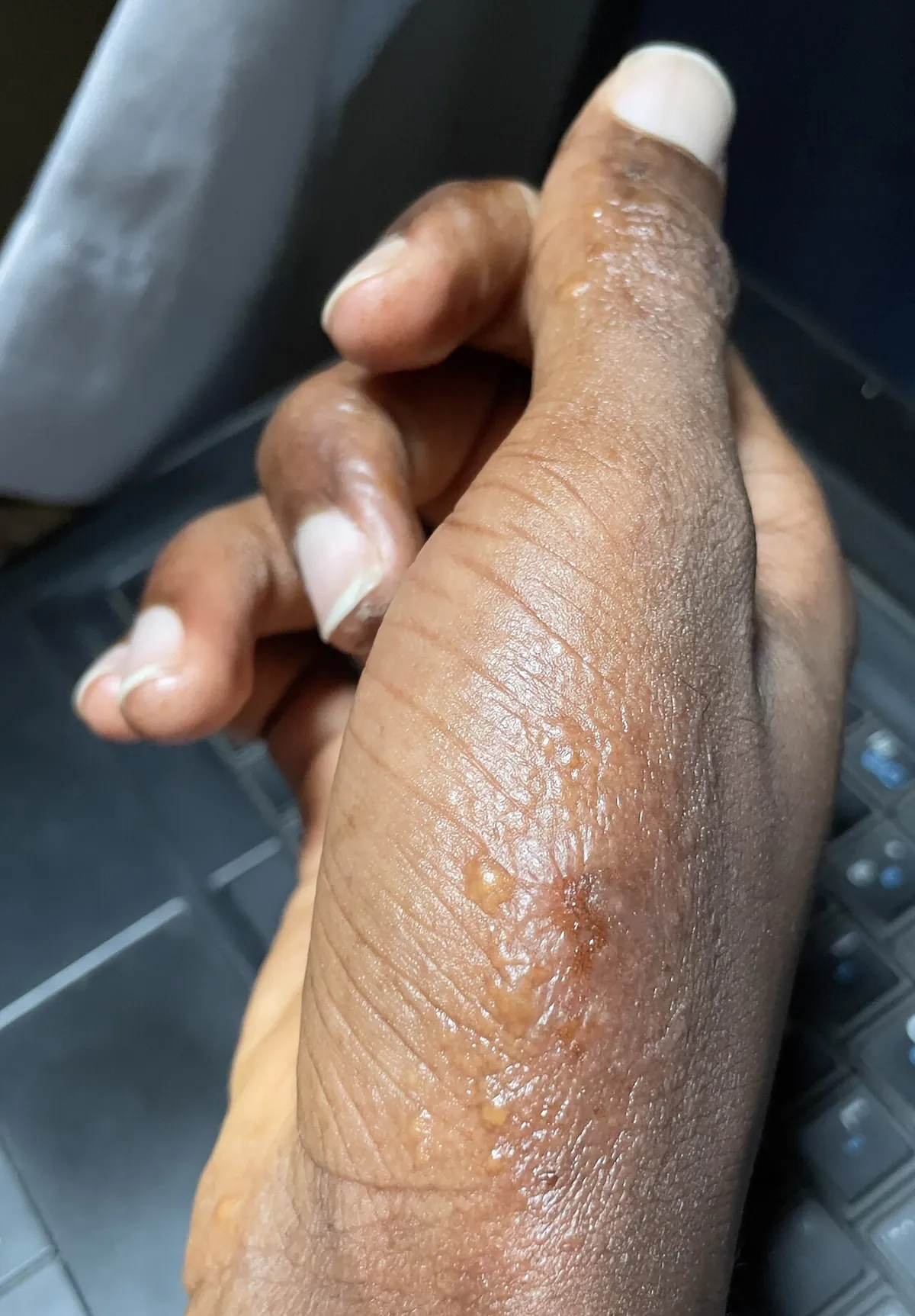
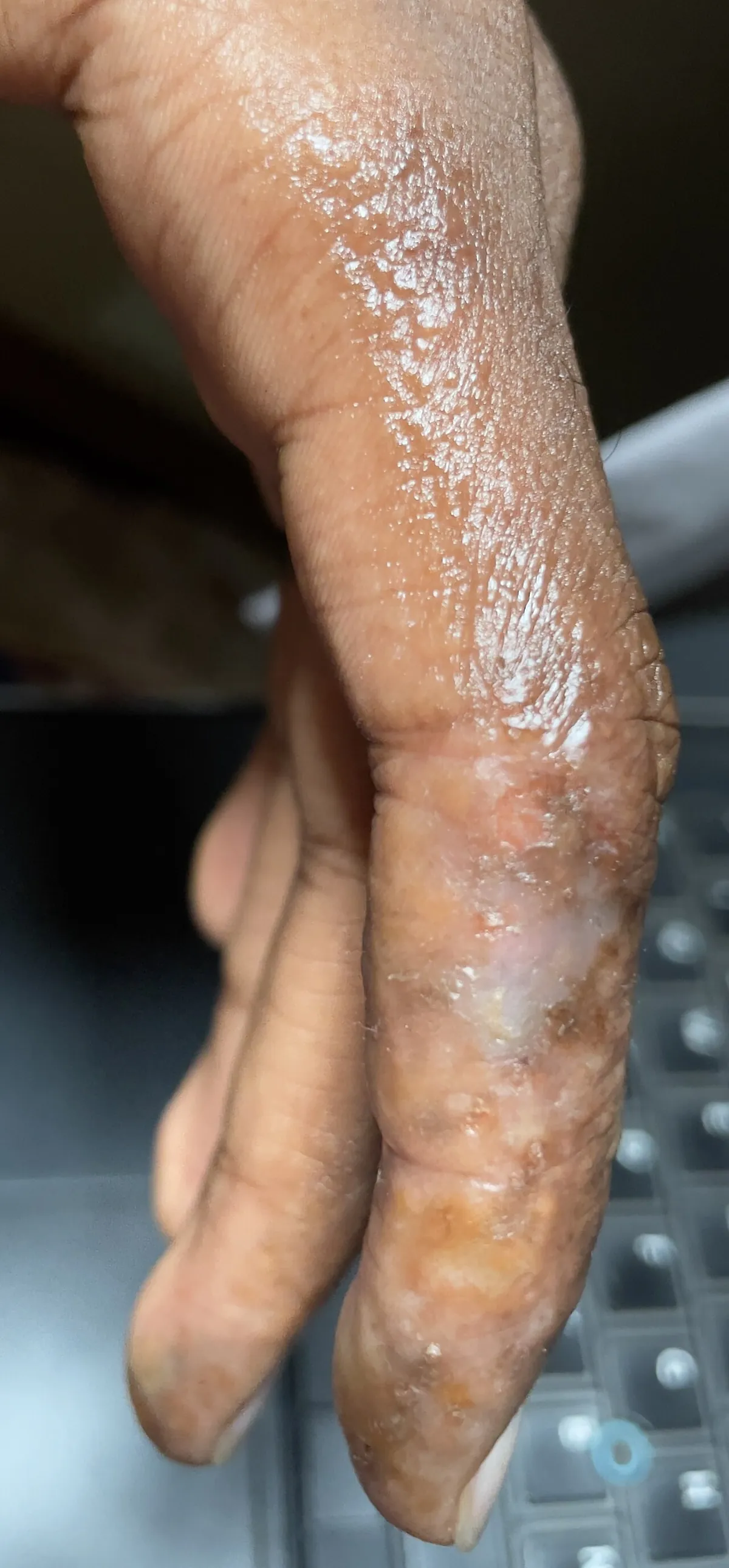
On lighter skin the bumps usually look red or pink. On brown and black skin they may be skin-colored or darker, and redness is harder to see. The NHS says the spots are more difficult to see on brown or black skin, but you should be able to feel them, and the rash may leave marks darker than your usual skin tone. Relying on itch, location and feel matters more than color.
Where on the body does it appear?
The CDC lists the spaces between the fingers, wrists, elbows, knees, armpits and waist as common sites. The AAD adds areas covered by clothing or jewelry, such as the belt line, buttocks and skin around the nipples, and notes that mites like to burrow between the fingers and around the nails.
The face is usually spared in adults. The AAD says adult mites rarely burrow into skin above the neck. Infants and young children are different: the CDC says their rash often appears on the head, face, neck, palms and soles.
Why does scabies itch so much at night?
The itch is an allergic reaction to the mites, their eggs and their waste. The CDC's treatment page explains that this reaction is why itching can continue for weeks after the mites are dead. The AAD describes the itch as mainly at night and intense enough to keep people awake. Night itch that also affects others in your home is one of the strongest clues to scabies.
How do you get scabies, and how contagious is it?
Scabies spreads mainly through prolonged, direct skin-to-skin contact with someone who has it, the CDC says. Sharing clothing, towels or bedding is a less common route. That is why it spreads easily within households, between sexual partners, and in childcare centers, nursing homes and other crowded settings.
- Delay before itching: the first time you get scabies, the CDC says symptoms typically take 4 to 8 weeks to develop, and you can spread it before you notice anything.
- Off the body: mites generally do not survive more than two to three days away from human skin.
- Number of mites: the AAD says typical scabies involves about 15 to 20 mites.
What is crusted scabies?
Crusted (Norwegian) scabies is a severe form. The CDC lists older adults, people with weakened immune systems such as those living with HIV, and people who cannot itch or scratch, for example after a spinal cord injury, as being at higher risk. Itching may be mild or absent. The AAD says people with it can have thousands of mites, and the crusts are thick, grayish and crumble easily. The CDC calls it very contagious, and outbreaks in care homes often start from a missed case. It needs medical treatment with both oral and topical medicine.
Is it scabies or something else?
| Condition | How it differs from scabies |
|---|---|
| Eczema | Dry, scaly, itchy patches in skin folds; often a long history; household members are not itchy |
| Hives | Raised welts that move around and fade within hours |
| Contact dermatitis | Rash in the exact spot that touched a trigger, such as a metal, plant or product |
| Insect bites | Scattered bumps on exposed skin that settle within days; no burrows |
| Folliculitis | Pus bumps centered on hair follicles, more sore than itchy |
| Ringworm | A few ring-shaped patches with a scaly edge, not dozens of bumps |
| Impetigo | Honey-colored crusts; it can also develop on top of scratched scabies |
The CDC notes that only a health care professional can diagnose scabies and prescribe the right treatment, so get any persistent, itchy rash checked before treating it yourself.
How is scabies treated?
Scabies needs a medicine that kills the mites, called a scabicide. Anti-itch creams alone will not cure it. The CDC's clinical guidance lists two first-line options for typical scabies.
Permethrin 5% cream
- FDA-approved for people 2 months and older.
- Applied to the whole body from the neck down and washed off after 8 to 14 hours. Infants and young children often need the scalp and face treated too, the AAD notes.
- The CDC says one application is safe and effective, but two or more applications about a week apart may be needed. The AAD and NHS describe repeating it after one week.
- Follow the label and your clinician closely. The AAD notes mites like the skin between the fingers and around the nails, so do not miss those areas.
Ivermectin tablets
- Oral ivermectin is not FDA-approved for scabies, the CDC notes, but it works about as well as permethrin.
- The CDC regimen is two doses based on body weight, taken 7 to 14 days apart with food.
- Its safety has not been established in children under 15 kg or in pregnancy.
- The AAD says it is often used for widespread or crusted scabies and in institutions such as nursing homes.
Other options
The CDC also lists spinosad 0.9% (FDA-approved in 2021 for ages 4 and older), crotamiton 10% for adults (with frequent treatment failure), and sulfur ointment. Lindane is restricted because of the risk to the nervous system. For crusted scabies, the CDC recommends oral ivermectin together with permethrin cream.
Who else needs treatment?
Treating only the person with the rash is the most common reason scabies keeps coming back. The AAD says everyone who lives with the patient and recent sexual partners need treatment, and "Even people who do not have any signs or symptoms must be treated." The NHS says everyone in the home should be treated at the same time. The CDC advises telling anyone you had direct skin-to-skin contact with in the previous two months so they can see a clinician, and avoiding skin-to-skin contact until your treatment is finished.
Do you need to clean your house after scabies?
A little, on the day you start treatment. The CDC says to wash bedding, clothing and towels in hot water and dry them in a hot dryer; temperatures above 50°C (122°F) for 10 minutes kill mites and eggs. Items that cannot be washed can be dry-cleaned or sealed in a plastic bag for at least 72 hours. The AAD also suggests vacuuming. The CDC's clinical overview says pesticide sprays or fogs are generally unnecessary and discouraged, and throwing out mattresses is generally unnecessary.
How long does the itch last after treatment?
The itch often outlasts the mites. The CDC says itching can continue for several weeks after the mites and eggs are dead, and the AAD notes the rash and itch can get worse for the first few days to a week before improving, with skin healing within about four weeks. Your clinician may suggest an antihistamine for sleep, an anti-itch lotion such as pramoxine, or a steroid cream for inflammation. A fragrance-free moisturizer or petrolatum helps skin that is dry from treatment.
Contact your clinician about retreatment if itching continues more than 2 to 4 weeks after treatment, or if new burrows or new bumps appear. Weekly photos of your hands and wrists in the same light can make it easier to tell whether the rash is fading or new spots are forming.
The NHS says adults and children aged 5 and over can go back to work or school once treatment has started, avoiding close contact for the first 24 hours, and that children under 5 can return to nursery 24 hours after the first treatment. Check your local school's rules.
When should you see a doctor about a scabies rash?
Scabies needs a prescription in most cases, so see a clinician or find a dermatologist if you think you have it. Get care promptly if:
- a baby or young child has the rash, especially on the face, palms or soles;
- scratched areas become painful, hot, swollen, crusted or pus-filled, or you have a fever, which can mean a bacterial infection;
- there are thick, gray, crumbly crusts, which can mean crusted scabies;
- you are pregnant or breastfeeding, or have a weakened immune system;
- itching is no better 2 to 4 weeks after treatment, or new bumps appear;
- several people in a care home, school or shelter are itchy.
Frequently asked questions
What does a scabies rash look like?
Small, very itchy, pimple-like bumps, often in a line, with scratch marks. You may see short, thread-like burrows between the fingers or on the wrists. On brown and black skin, the bumps can be harder to see but can be felt.
Why is scabies itch worse at night?
The itch is an allergic reaction to the mites and their waste, and it is typically most intense at night. Night itch that others in your home also have is a strong clue to scabies.
Can scabies go away on its own?
No. Scabies needs a scabicide such as permethrin cream or ivermectin tablets prescribed by a clinician. Anti-itch creams alone do not kill the mites.
Does my family need to be treated for scabies?
Yes. The AAD and NHS say everyone in the household and recent sexual partners should be treated at the same time, even if they have no symptoms, or the mites can pass back and forth.
How long does scabies itch after treatment?
Itching can continue for several weeks after the mites are dead. Contact your clinician if it lasts more than 2 to 4 weeks after treatment or if new burrows or bumps appear.
Can you get scabies on your face?
It is uncommon in adults, since mites rarely burrow above the neck. In infants and young children, the rash often appears on the head, face, neck, palms and soles, and in crusted scabies.
Sources
Pori is a wellness and skincare education app, not a medical device. This article is for general information and isn't medical advice. For anything that worries you, see a dermatologist.