 Pori

- Steroid-induced rosacea is a red, bumpy, burning rash on the mid-face that can follow weeks of a potent steroid cream on facial skin.
- Topical steroid withdrawal causes burning, solid redness that can spread beyond the treated area; the UK regulator calls severe cases very infrequent.
- Taper with a doctor, by using the cream less often or switching to a weaker one, to lower the risk of a severe rebound flare.
- Treatment includes gentle care, non-steroid creams and often doxycycline for months; steroids remain safe when used as directed.
Steroid-induced rosacea is a red, bumpy, burning rash on the middle of the face that can develop after several weeks of using a steroid cream on facial skin, and it often flares when the cream is stopped. Topical steroid withdrawal (TSW) is a related, less understood reaction: burning, bright red skin that appears after long-term steroid use ends. Both are uncommon when steroids are used as prescribed, and both are best handled by tapering off slowly with a doctor rather than stopping overnight.
Pori does not diagnose skin conditions; its selfie scans and photo diary in Pori can help you keep dated, consistent photos to show a dermatologist and see whether treatment is working.
What is steroid-induced rosacea?
DermNet describes steroid rosacea as a rosacea-like rash on the mid-face caused by potent topical steroids or their withdrawal. It is considered a variant of, or possibly the same condition as, periorificial (perioral) dermatitis, which we cover in our perioral dermatitis guide. It is most often seen in adult women but can affect men and children.
It is different from steroid acne, which DermNet notes is caused by steroids taken by mouth, and from ordinary rosacea, which develops without steroid use. Our guide to the types of rosacea explains the usual forms.
What does it look like?
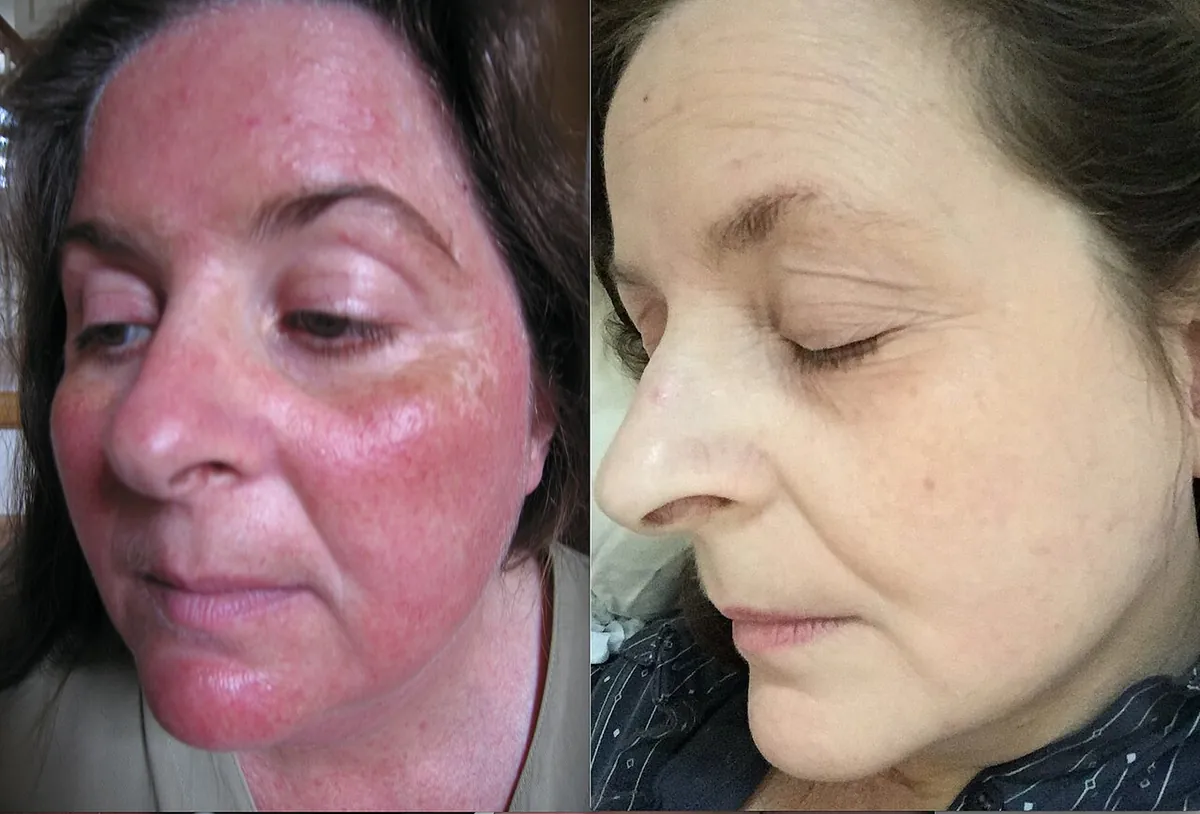
- Redness across the cheeks, forehead, chin or around the mouth and eyes, often where the cream was applied.
- Small red bumps and pus-filled spots, sometimes with fine scale.
- Burning and itching, and skin that reacts to almost anything put on it.
- Small visible blood vessels that can develop over time.
On brown and black skin, the AAD notes that rosacea redness may look red, violet or brown, so the bumps and the burning are often easier to spot than the color itself.
How do steroid creams cause a rosacea-like rash?
Nobody knows exactly. DermNet lists several theories: more demodex mites and other microbes on the skin, new blood vessel growth with rebound widening of the vessels, and an immune reaction that releases inflammatory chemicals. What is clear is the pattern of risk:
- Potency. Strong steroids on facial skin carry the most risk. DermNet says mild steroids, especially used infrequently, are less likely to cause it.
- Time. Symptoms appear after several weeks of applying a steroid to the face.
- The face itself. Facial skin is thin. The AAD notes that skin thinning is more likely when a high-potency topical corticosteroid is applied to the face or neck.
A common pattern is a steroid cream prescribed for a rash elsewhere, or borrowed, that gets used on the face for redness or itch. It works at first, so it is used again, and the skin seems to need it more and more.
What is topical steroid withdrawal?
Topical steroid withdrawal, also called topical steroid addiction or red skin syndrome, is a reaction that the National Eczema Association describes as the emergence of skin symptoms upon cessation of corticosteroid application. It remains under-researched and is often mistaken for a flare of eczema. The NEA lists burning or stinging, bright red skin, itching, pain, peeling, swelling and trouble sleeping, starting days to weeks after stopping.
The UK medicines regulator, the MHRA, reviewed the evidence in 2021. It says severe withdrawal reactions are very infrequent and usually follow long-term or inappropriate use of moderate to high potency products, typically at least daily for longer than a year. It adds that in children, reactions have occurred after as little as 2 months of daily use, and that they are most common after treating the face or genitals. The signs it highlights:
- Burning, more than itch, is the main symptom.
- Redness is solid and continuous rather than patchy.
- Redness spreads beyond the area that was treated.
A 2015 systematic review in the Journal of the American Academy of Dermatology pooled 34 studies. In those reports, withdrawal mostly affected the face and genital area (99.3%) and women (81.0%), usually after long-term, inappropriate use of potent steroids. Burning and stinging were the most common symptoms (65.5%), and redness the most common sign (92.3%). The authors described two forms: a papulopustular form with bumps, which looks like steroid rosacea, and an erythematoedematous form with more burning and swelling. They also noted that the quality of the evidence was low.
Should you be afraid of steroid creams?
No. Topical steroids are safe and effective for eczema, psoriasis and many rashes when they are used as directed. The AAD says side effects are rare when this medicine is used as directed by a dermatologist. The MHRA warns that using too little can drag out treatment and raise the risk of some side effects. Stopping a treatment you need out of fear leaves eczema or another condition uncontrolled, which has its own costs for your skin and sleep.
The useful habits are simple:
- Use a steroid on the face only when a clinician has said to, at the strength and for the time they gave you.
- Ask before putting a cream prescribed for your body on your face, and never borrow someone else's.
- Follow the label on over-the-counter hydrocortisone, and ask a doctor if a facial rash keeps coming back.
- Ask your clinician at each visit whether you still need the steroid, and how to step down.
Why should you taper steroids under a doctor?
Because stopping a strong steroid suddenly can set off a rebound flare that is worse than the original rash. DermNet advises withdrawing the steroid slowly, by applying it less often or switching to a less potent steroid, to reduce the risk of a severe flare. The NEA says gradual tapering under the supervision of a healthcare professional is often recommended, and the MHRA suggests long-term users consider reducing potency, frequency or both.
A doctor also helps in three other ways:
- Telling a flare from withdrawal. If your eczema returns where it always was, that is usually the eczema. Burning redness that spreads past the treated area points elsewhere. The MHRA advises that if your skin worsens within 2 weeks of stopping, you should not restart the steroid without consulting your doctor.
- Checking for look-alikes. A fungal infection hidden by steroids, called tinea incognito, can look like steroid rosacea and needs antifungal treatment.
- Treating the condition underneath with non-steroid options while you step down.
How is steroid rosacea treated?
DermNet lists these steps, alongside slowly stopping the steroid:
- Plain, non-oily moisturizers, and a pause on most other facial products. Our guides to the best face wash for rosacea and the best moisturizer for rosacea cover gentle options.
- Pimecrolimus cream, a non-steroid anti-inflammatory, which may help for a short time.
- Oral antibiotics from the tetracycline family, such as doxycycline, often for several months, used here for their anti-inflammatory effect.
- Vascular laser later on for visible blood vessels that remain.
DermNet says most cases respond well to treatment, though small visible vessels may persist. Expect a flare before improvement, and judge progress over weeks, not days. The AAD notes that most skin side effects of steroids go away once the medicine is stopped, though it may take months. For topical steroid withdrawal after eczema treatment, the NEA says non-steroidal treatments may be used to control the eczema, with regular follow-up.
What else can look like steroid rosacea?
| Condition | How it differs |
|---|---|
| Rosacea | Develops without steroid use; flushing with heat, alcohol or sun is typical |
| Perioral dermatitis | Milder cluster of tiny bumps around the mouth, nose or eyes; often steroid-related too |
| Tinea faciei or tinea incognito | Fungal rash, often with a raised, scaly edge; steroids can hide and spread it |
| Eczema flare | Itch is the main symptom and the rash returns in its usual places |
| Contact dermatitis | Itchy rash where a product touched; can be an allergy to an ingredient in the cream itself |
| Lupus malar rash | Butterfly rash that spares the folds from nose to mouth, often with joint pain or tiredness |
For a wider view, see our guide to rashes on the face.
When should you see a doctor?
- Your face burns or reddens after you stop a steroid cream. Don't restart it on your own.
- Redness spreads beyond where you applied the cream, or the skin oozes, swells or cracks.
- You have used a steroid on your face for more than a few weeks and want to stop.
- A child has used a steroid daily for months, especially on the face or diaper area.
- The rash is near your eyes, or you have fever or signs of infection such as yellow crusts.
- You feel unable to sleep or cope. The NEA lists insomnia among symptoms, and support matters.
A dermatologist is the right person for this; you can find a dermatologist near you. Bring the cream or a photo of its label, and write down how long and how often you used it.
How can a photo diary help while you taper?
Withdrawal and tapering take weeks, and bad days can make it feel as if nothing is changing. A photo in the same light every few days, with a note of each dose step, shows the real direction. It also gives your doctor a clear record if the redness spreads beyond the area you treated, which is one of the signs that separates withdrawal from a regular flare.
Frequently asked questions
What is steroid-induced rosacea?
A rosacea-like rash of redness, small bumps and burning on the middle of the face that can follow several weeks of using a potent steroid cream on facial skin. It often flares when the steroid is stopped.
How long does steroid rosacea take to go away?
Expect weeks to months. DermNet says doxycycline may be needed for several months, most cases respond well, and small visible blood vessels may remain. A rebound flare is common at the start.
Should I stop my steroid cream right away?
Talk to your doctor first. DermNet and the National Eczema Association advise tapering, by using it less often or switching to a weaker steroid, to lower the risk of a severe rebound flare.
Is topical steroid withdrawal real?
It is recognized but under-researched. The UK regulator MHRA says severe reactions are very infrequent and usually follow long-term daily use of moderate to strong steroids, most often on the face or genitals.
Can over-the-counter hydrocortisone cause steroid rosacea?
Mild steroids used briefly are much less likely to cause it, but repeated use on the face can still aggravate rosacea and perioral dermatitis. Follow the label and ask a doctor if a facial rash keeps returning.
Are steroid creams safe for eczema?
Yes, when used as directed. The AAD says side effects are rare with dermatologist-guided use, and undertreating eczema has its own harms. Ask how strong your cream is and how long to use it.
Sources
- DermNet: Steroid rosacea
- MHRA Drug Safety Update: Topical corticosteroids and the risk of topical steroid withdrawal reactions
- Hajar T et al. A systematic review of topical corticosteroid withdrawal. J Am Acad Dermatol 2015
- National Eczema Association: Topical steroid withdrawal
- American Academy of Dermatology: Corticosteroids applied to the skin
- DermNet: Rosacea
- American Academy of Dermatology: Rosacea signs and symptoms
Pori is a wellness and skincare education app, not a medical device. This article is for general information and isn't medical advice. For anything that worries you, see a dermatologist.