Pori
- EltaMD belongs to Colgate-Palmolive, which announced its purchase in December 2017; La Roche-Posay has belonged to L'Oréal since 1989.
- EltaMD builds most sunscreens on zinc oxide, often with one chemical filter. La Roche-Posay's Anthelios sunscreens mostly use chemical filters, and its US Anthelios UVDefense adds bemotrizinol.
- Acne- or rosacea-prone skin: EltaMD UV Clear SPF 46. Dry skin on a budget: La Roche-Posay Toleriane Double Repair UV. Beach and sport: Anthelios Melt-in Milk SPF 60.
- La Roche-Posay usually costs less per ounce: Melt-in Milk works out to about $7.60 an ounce against about $27 for EltaMD UV Clear, as of November 2026.
Choose EltaMD if you want a zinc oxide sunscreen for acne-prone, rosacea-prone or reactive skin, and UV Clear SPF 46 is its best-known pick for that. Choose La Roche-Posay if you want more filters, more textures and a lower price per ounce, including water-resistant Anthelios lotions for sport and the new Anthelios UVDefense with bemotrizinol. Both brands make fragrance-free face sunscreens at SPF 30 or higher.
Before you spend $40 or more on a bottle, you can scan its barcode or label with the ingredient scanner in Pori to check the formula against your skin type. Pori reads ingredients; it does not diagnose skin conditions.
Below we compare who owns each brand, how their filter choices differ, price per ounce, the main sunscreens side by side, and four matchups. We compared published ingredient lists, Drug Facts labels on DailyMed, brand claims and listed prices; we did not test these products on skin. Prices are US list prices as of November 2026, with the retailer named.
Who owns EltaMD and La Roche-Posay?
EltaMD belongs to Colgate-Palmolive. On December 18, 2017, Colgate announced it would buy EltaMD and PCA Skin, describing EltaMD as a physician-dispensed sun care brand. Its US Drug Facts labels list CP Skin Health Group as the company. The brand grew up in dermatologists' offices, which is why it is still sold at clinics as well as online.
La Roche-Posay belongs to L'Oréal, which bought it in 1989. It sits in L'Oréal's Dermatological Beauty division with CeraVe, Vichy and SkinCeuticals. Our EltaMD skincare guide and La Roche-Posay skincare guide cover the full ranges.
What is the difference between EltaMD and La Roche-Posay sunscreens?
The main difference is the filters.
- EltaMD is built on zinc oxide, the mineral filter that covers UVA and UVB. Most of its face formulas are hybrids: UV Clear and UV Daily pair zinc oxide 9% with octinoxate 7.5%, and UV Physical pairs zinc oxide with titanium dioxide only. The bases are fragrance-free, and UV Clear adds niacinamide.
- La Roche-Posay mostly uses chemical filters: avobenzone for UVA with homosalate, octisalate and octocrylene. In June 2026 the FDA added bemotrizinol to the list of permitted sunscreen filters, and La Roche-Posay's US Anthelios UVDefense SPF 50 now lists it at 2%. It also sells tinted mineral Anthelios fluids.
Neither approach is safer for most people. Zinc oxide tends to suit skin that stings with chemical filters, and it can leave a white cast. Chemical filters spread clear and thin, and octocrylene is an occasional cause of contact allergy. Our guides to zinc oxide sunscreen and chemical sunscreen filters explain both.
How do EltaMD and La Roche-Posay sunscreens compare?
| Sunscreen | UV filters (Drug Facts) | Water resistance | Price (November 2026) | Per ounce |
|---|---|---|---|---|
| EltaMD UV Clear SPF 46 | Zinc oxide 9%, octinoxate 7.5% | None claimed | $46 for 1.7 oz (eltamd.com) | About $27.06 |
| EltaMD UV Daily SPF 40 | Zinc oxide 9%, octinoxate 7.5% | None claimed | $42 for 1.7 oz (Dermstore) | About $24.71 |
| EltaMD UV Physical SPF 41 (tinted) | Zinc oxide 9%, titanium dioxide 7% | 40 minutes | $50 for 3 oz (eltamd.com) | About $16.67 |
| La Roche-Posay Toleriane Double Repair UV SPF 30 | Avobenzone 3%, homosalate 5%, octisalate 5%, octocrylene 7% | None claimed | $28.99 for 3.38 oz (Ulta) | About $8.58 |
| La Roche-Posay Anthelios UVDefense SPF 50 | Avobenzone 3%, bemotrizinol 2%, homosalate 11%, octisalate 5%, octocrylene 6% | None claimed | $39.99 for 1.7 oz (brand site) | About $23.52 |
| La Roche-Posay Anthelios Clear Skin Dry Touch SPF 60 | Avobenzone 3%, homosalate 15%, octisalate 5%, octocrylene 7% | 80 minutes | $20.99 for 1.7 oz (Ulta) | About $12.35 |
| La Roche-Posay Anthelios Melt-in Milk SPF 60 | Avobenzone 3%, homosalate 10%, octisalate 5%, octocrylene 7% | 80 minutes | $37.99 for 5 oz (Target) | About $7.60 |
EltaMD prices are similar at Dermstore and on eltamd.com. Labels change, so check the Drug Facts box on the box you buy.
EltaMD UV Clear or La Roche-Posay for acne-prone and oily skin?
EltaMD UV Clear SPF 46 is the classic pick for acne-prone and rosacea-prone skin. It is a light, oil-free lotion with zinc oxide 9% and octinoxate 7.5%, plus niacinamide, sodium hyaluronate and a little lactic acid, and the brand calls it non-comedogenic. It comes untinted and tinted. The catches are the price, about $27 an ounce, and no water-resistance claim. Our UV Clear review goes line by line.
La Roche-Posay Anthelios Clear Skin Dry Touch SPF 60 is the cheaper, more matte option. It uses four chemical filters with silica and perlite to absorb oil, is fragrance-free, and is water resistant for 80 minutes, at $20.99 for 1.7 oz. It suits oily skin that sweats, and skin that does fine with chemical filters.
- Pick UV Clear if chemical filters sting you, or if redness and flushing are part of your picture.
- Pick Anthelios Clear Skin if shine is the main complaint, or if you need water resistance for workouts.
Our best sunscreen for acne-prone skin and best sunscreen for rosacea compare more choices.
UV Clear Broad-Spectrum SPF 46
Oil-free zinc oxide and octinoxate sunscreen with niacinamide for acne-prone, easily flushed skin.
Suits: Sensitive, Oily, Combination, Normal skin
From Pori's catalogue. Amazon links carry our Associates tag: Pori earns from qualifying purchases, at no cost to you. No brand pays to be listed. Photos: Open Beauty Facts contributors, CC BY-SA 3.0.
EltaMD UV Daily or Toleriane Double Repair UV for dry skin?
Both are moisturizer-plus-SPF lotions for normal to dry skin. EltaMD UV Daily SPF 40 uses the same two filters as UV Clear in a richer base with petrolatum high on its list and sodium hyaluronate. La Roche-Posay Toleriane Double Repair Face Moisturizer UV SPF 30 pairs four chemical filters with ceramide NP and niacinamide, and costs $28.99 for 3.38 oz, about a third of EltaMD's price per ounce. Our Toleriane Double Repair UV review covers it.
For most dry skin, the La Roche-Posay lotion is the better value. Choose EltaMD UV Daily if you want zinc oxide in your morning moisturizer or react to avobenzone-based formulas.
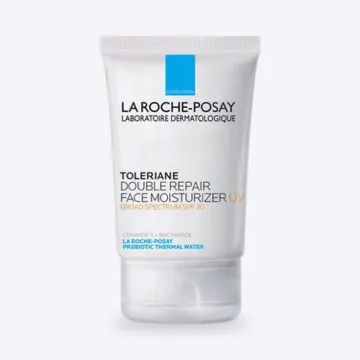
Toleriane Double Repair Face Moisturizer UV SPF 30
SPF 30 sunscreen with niacinamide, avobenzone and homosalate. Fragrance-free.
Suits: Normal, Dry, Oily, Combination, Sensitive skin
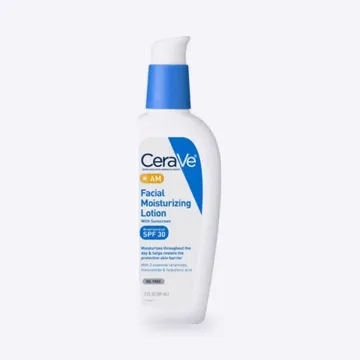
AM Facial Moisturizing Lotion SPF 30
SPF 30 sunscreen with niacinamide, homosalate and octinoxate. Fragrance-free.
Suits: Normal, Dry, Oily, Combination, Sensitive skin
From Pori's catalogue. Amazon links carry our Associates tag: Pori earns from qualifying purchases, at no cost to you. No brand pays to be listed. Photos: Open Beauty Facts contributors, CC BY-SA 3.0.
EltaMD UV Physical or a La Roche-Posay mineral sunscreen?
If you want mineral filters only, EltaMD UV Physical SPF 41 is the stronger match. It pairs zinc oxide 9% with titanium dioxide 7% and is tinted with iron oxides, which hide the white cast and add some protection against visible light, a plus for melasma. It comes in one universal shade, which can look ashy or orange on some skin tones, and it is water resistant for 40 minutes.
La Roche-Posay's tinted mineral Anthelios fluids are built on titanium dioxide, and the SPF 40 fluid comes in Medium, Medium Deep and Deep shades, which helps with matching. Both brands' tinted mineral formulas are good choices for reactive skin. Our best mineral sunscreen for sensitive skin and best sunscreen for melasma compare the shades and filters.
Which is better for sport and the beach?
La Roche-Posay. Anthelios Melt-in Milk SPF 60 is fragrance-free, water resistant for 80 minutes, works on face and body, and costs about $7.60 an ounce in the 5 oz bottle. Our Melt-in Milk review covers it. EltaMD sells UV Sport SPF 50 ($32 for 3 oz), a zinc oxide hybrid for long outdoor days, which costs more per ounce. Reapply any water-resistant sunscreen after the time on the label, and use about a teaspoon for face and neck, as our guide to how much sunscreen to use explains.
Is EltaMD worth the price over La Roche-Posay?
It can be, for specific skin. EltaMD's value is a fragrance-free zinc oxide base with skin-friendly extras, which many people with acne, rosacea or chemical-filter sensitivity wear comfortably every day. If your skin does fine with chemical filters, La Roche-Posay gives you the same broad-spectrum protection, more water-resistant options and a lower price per ounce. The best sunscreen is the one you will apply generously every morning.
Can you use EltaMD and La Roche-Posay together?
Yes, and many people do. A common split is an EltaMD sunscreen on the face on ordinary days and a big bottle of Anthelios Melt-in Milk for the body, the beach and the gym bag, which keeps the expensive tube for where you notice texture most. Don't layer two sunscreens to add up SPF numbers, because protection doesn't stack that way; one full layer of either does the job. If you wear makeup, let the sunscreen set for a few minutes first. Our guide to sunscreen under makeup covers textures that pill less.
So, EltaMD or La Roche-Posay: who should pick which?
- Acne-prone or rosacea-prone skin: EltaMD UV Clear SPF 46.
- Oily skin that sweats: La Roche-Posay Anthelios Clear Skin Dry Touch SPF 60.
- Dry skin: La Roche-Posay Toleriane Double Repair UV for value; EltaMD UV Daily if you want zinc.
- Mineral only or melasma: EltaMD UV Physical SPF 41, or a tinted Anthelios mineral fluid if the shade fits better.
- Beach and sport: La Roche-Posay Anthelios Melt-in Milk SPF 60.
For other sunscreen head-to-heads, read Supergoop vs La Roche-Posay and Avène vs La Roche-Posay, or browse sunscreens in our catalogue.
Frequently asked questions
Is EltaMD or La Roche-Posay better for acne-prone skin?
EltaMD UV Clear SPF 46 is the classic pick: zinc oxide 9% and octinoxate 7.5% with niacinamide, labeled non-comedogenic. La Roche-Posay Anthelios Clear Skin Dry Touch SPF 60 is cheaper, more matte and water resistant.
Are EltaMD sunscreens mineral?
Most are hybrids. UV Clear and UV Daily combine zinc oxide with octinoxate. UV Physical SPF 41 uses zinc oxide and titanium dioxide only.
Does La Roche-Posay sell a sunscreen with bemotrizinol in the US?
Yes. Anthelios UVDefense SPF 50 lists bemotrizinol 2% with avobenzone, homosalate, octisalate and octocrylene on its US Drug Facts label. It lists at $39.99 for 1.7 oz on the brand site.
Who owns EltaMD?
Colgate-Palmolive, which announced its purchase of EltaMD and PCA Skin in December 2017. La Roche-Posay belongs to L'Oréal.
Is EltaMD worth the price?
For skin that stings with chemical filters or is prone to acne and rosacea, many people find it worth it. If chemical filters suit you, La Roche-Posay costs far less per ounce for similar broad-spectrum protection.
Which is better for swimming, EltaMD or La Roche-Posay?
La Roche-Posay Anthelios Melt-in Milk SPF 60 is water resistant for 80 minutes and costs about $7.60 an ounce. EltaMD UV Clear and UV Daily make no water-resistance claim.
Sources
- Colgate-Palmolive: Colgate announces acquisition of PCA Skin and EltaMD
- Cosmetics Business: Something in the water for La Roche-Posay
- DailyMed: EltaMD UV Clear SPF 46 label
- DailyMed: EltaMD UV Physical SPF 41 label
- EltaMD: UV Clear Broad Spectrum SPF 46
- DailyMed: La Roche-Posay Anthelios UVDefense SPF 50 label
- DailyMed: La Roche-Posay Anthelios Melt-in Milk SPF 60 label
- Target: La Roche-Posay Anthelios Melt-in Milk SPF 60, 5 oz
- Ulta: La Roche-Posay Anthelios Clear Skin Dry Touch SPF 60
- FDA: Questions and answers on FDA's regulatory actions on OTC sunscreens
Pori is a wellness and skincare education app, not a medical device. This article is for general information and isn't medical advice. For anything that worries you, see a dermatologist.