Pori

- Tula was co-founded in 2014 by gastroenterologist Dr. Roshini Raj, Ken Landis and Dan Reich, and Procter & Gamble bought it in January 2022.
- Its labels say "Does Not Contain Live Cultures": the products use ferment lysates and prebiotic sugars, plus milk protein.
- Research on topical probiotics is early; the best cosmetic evidence is one small, brand-run lysate trial on reactive skin.
- The Cult Classic cleanser ($24) and 24-7 cream ($88) are solid basics; pick the Fragrance Free versions if your skin is sensitive.
Tula is a US skincare brand co-founded in 2014 by gastroenterologist Dr. Roshini Raj and built around probiotic extracts, prebiotics and "superfoods." Procter & Gamble bought it in January 2022. Its products use fermented bacterial lysates and prebiotic sugars, its labels state they contain no live cultures, and the evidence for those ingredients on skin is early and comes mostly from small, industry-run studies.
If you are deciding between a Tula bottle and something cheaper, you can scan the barcode or label with the ingredient scanner in Pori to check the formula against your skin type. Pori flags ingredients such as fragrance and milk proteins; it does not diagnose skin conditions.
This guide covers who founded and owns Tula, what "probiotic" means on its labels, what the research on topical probiotics says, and which products are worth a look. We compared published ingredient lists, brand claims and listed prices; we did not test these products on skin. Prices are Ulta Beauty list prices as of November 2026.
Who founded Tula and who owns it now?
Tula was co-founded in 2014 by Dr. Roshini Raj, a board-certified gastroenterologist and internist, with Ken Landis, a co-founder of Bobbi Brown Cosmetics, and Dan Reich, a technology entrepreneur. Raj is the public face of the brand. Tula's site says she studied the microbiome and founded the brand, whose name is Sanskrit for "balance," to bring that idea to skin.
Procter & Gamble agreed to buy Tula in January 2022, with terms undisclosed. At the time Tula was backed by the private equity firm L Catterton, and trade press reported it was on track for about $150 million in 2021 sales. P&G said Tula would keep running independently under its chief executive, Savannah Sachs. The brand's site now lists TULA Life, Inc. and refers to "other trusted P&G brands."
What does "probiotic skincare" mean on a Tula label?
A probiotic, by the standard scientific definition, is a live microorganism that gives a health benefit when given in adequate amounts. Tula's products do not contain live bacteria. Its US labels on Ulta say so plainly: "Does Not Contain Live Cultures." What they contain are three kinds of microbiome-themed ingredients.
- Ferment lysates: broken-down, non-living bacteria and the substances they made. Tula uses bifida ferment lysate, lactococcus ferment lysate and lactobacillus ferment. These are sometimes called postbiotics.
- Prebiotics: sugars and plant fibers meant to feed helpful skin bacteria, such as inulin, chicory root extract, alpha-glucan oligosaccharide and yacon root juice.
- Dairy ingredients: lactose, milk protein and, in the cleanser, yogurt powder. The labels note "Contains Milk Proteins."
Tula's own wording has shifted toward prebiotics. Its About page now says the products are "formulated with prebiotics to help nourish beneficial bacteria" and describes the approach as "skin wellness." The product photos still say "Probiotics & Superfoods."
Is there evidence that topical probiotics work?
Some, and it is early. Here is what the research we found shows.
- A 2019 systematic review in Experimental Dermatology looked at animal and human studies of probiotics applied to skin. It found the idea promising, especially because oral probiotics have shown benefits in eczema, acne and rosacea, and it concluded that more research is needed.
- A bifidobacterium lysate trial from L'Oréal's research team tested a cream with 10% Bifidobacterium longum lysate on 66 women with reactive skin for two months. The lysate group had less stinging and better barrier resistance than the control group. It was one small, brand-run study, and Tula does not disclose how much bifida ferment lysate its products contain.
- Live bacteria for eczema is a separate line of research. University of California, San Diego scientists showed that some harmless skin bacteria kill Staphylococcus aureus, and a 2021 phase 1 trial applied a live strain, Staphylococcus hominis A9, to 54 adults with eczema. It was safe and reduced S. aureus, but eczema severity did not differ significantly across the whole group. That work uses living, selected strains under study conditions, which no cosmetic offers.
The fair summary: microbiome skincare is a real research field, lysates have a little supportive evidence for soothing reactive skin, and there is no good evidence yet that any cosmetic "balances" your microbiome in a way you would notice. Tula's results come from the same well-understood ingredients as other brands: gentle surfactants, humectants such as glycerin and hyaluronic acid, and emollients such as squalane.
Is Tula's Cult Classic cleanser good?
The Cult Classic Purifying Face Cleanser is Tula's best-known product. It lists at $24 for 4.2 oz at Ulta, and Ulta's page repeats the brand's claim that one sells every 30 seconds. It is a gel cleanser built on disodium laureth sulfosuccinate and gentle glucoside surfactants, with bifida ferment lysate, hydrolyzed rice protein, turmeric, green tea, blueberry and chicory root extracts, yogurt powder, milk protein and panthenol.
The original version lists fragrance plus alpha-isomethyl ionone, benzyl benzoate, citronellol, hexyl cinnamal, limonene and linalool, all labeled fragrance allergens. Tula now sells a Fragrance Free version with the same base ($34 for 6.7 oz), which is the better choice for sensitive skin. As a light gel, it reads best for normal, oily and combination skin; very dry skin may prefer Tula's newer Rich Rinse Nourishing Cream Cleanser ($34 for 6.7 oz), which adds four ceramides and cholesterol but also lists fragrance. See types of face cleansers for how these compare.
Is Tula 24-7 Moisture worth it?
The 24-7 Moisture Hydrating Day & Night Cream is Tula's best-selling moisturizer. It lists at $88 for 3.4 oz at Ulta, and the Fragrance Free version lists at $58 for 1.5 oz. The base is water, ethylhexyl palmitate, squalane, glycerin, caprylic/capric triglyceride, cetyl alcohol and dimethicone, a classic cream. Then come the microbiome ingredients (lactococcus ferment lysate, bifida ferment lysate, lactobacillus and lactobacillus ferment), sodium hyaluronate, lactic acid at a low position, collagen amino acids, and fruit and vegetable extracts.
It is a well-made, medium-weight moisturizer for normal to dry skin. Its hydration comes from glycerin, squalane and hyaluronate, which cost far less elsewhere. The scented version lists fragrance, alpha-isomethyl ionone, benzyl benzoate, hexyl cinnamal and linalool, so choose the Fragrance Free jar if your skin reacts easily. Compare it with others in types of moisturizers or our moisturizers for dry skin list.
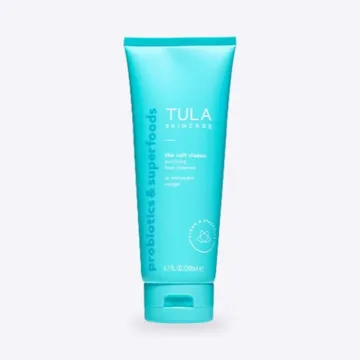
The Cult Classic Purifying Face Cleanser
Face cleanser with green tea extract, glycerin and panthenol.
Suits: Normal, Oily, Combination skin
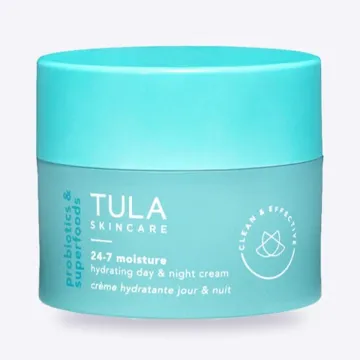
24-7 Moisture Hydrating Day & Night Cream
Moisturizer with squalane, glycerin and green tea extract.
Suits: Normal, Dry, Oily, Combination skin
From Pori's catalogue. Amazon links carry our Associates tag: Pori earns from qualifying purchases, at no cost to you. No brand pays to be listed. Photos: Open Beauty Facts contributors, CC BY-SA 3.0.
What else does Tula make?
- Protect + Glow Daily Sunscreen Gel SPF 30 ($58 at Ulta): a chemical sunscreen with avobenzone 3%, homosalate 10% and octisalate 5%, plus mica for a glow.
- Acne products: a Keep It Clear foam cleanser, a Breakout Star moisturizer and a Clear Up pore-clearing gel.
- Treatments: a retinal and peptide serum, a niacinamide dark spot serum, a vitamin C serum and a 10% glycolic toner.
- Eye products: several balms and creams, including the Glow & Get It cooling eye balm.
The treatment products are where Tula uses actives with real evidence, such as retinal, niacinamide and glycolic acid. As with any active, add one at a time; our guide to introducing new products shows how.
Is Tula good for sensitive skin or dairy allergies?
The Fragrance Free cleanser and cream are reasonable choices for sensitive skin. The original versions, the Rich Rinse cleanser and many other Tula products list fragrance and several fragrance allergens. If you have a known allergy to fragrance mix or eczema, read the label first and patch test.
The cleanser and moisturizer also contain milk protein and lactose. People with a confirmed milk allergy, and parents of children with one, may prefer to avoid them. If you have eczema or a diagnosed allergy, ask your dermatologist or allergist.
How do I build a simple Tula routine?
Tula works fine as part of a mixed routine. A short version looks like this.
- Cleanse: the Cult Classic cleanser, Fragrance Free if you are sensitive, morning and night.
- Treat: one active at a time, at night. A retinoid for lines or texture, or niacinamide for tone. Our retinal vs retinol guide explains the difference.
- Moisturize: 24-7 Moisture, or any moisturizer with glycerin and squalane that suits your skin.
- Protect: broad-spectrum SPF 30 or higher every morning, from Tula or another brand.
The microbiome ingredients are a bonus in this routine. The cleanser, moisturizer and sunscreen do the heavy lifting, whichever brand you buy them from. If a new product stings or causes bumps, stop it and see our guide to breaking out after a new product.
Is Tula worth the price?
- Worth it if: you like the textures and want a gentle cleanser or a comfortable cream, ideally in the Fragrance Free versions.
- Skip it if: you are paying mainly for the probiotic story. The microbiome ingredients have limited evidence, and the core hydration comes from inexpensive basics.
- Best value buy: the Cult Classic cleanser at $24, which is closer to drugstore pricing than the rest of the range.
For other brands read the same way, see our Shiseido, Fresh, CeraVe and La Roche-Posay guides, or browse our cleansers catalogue.
Frequently asked questions
Who owns Tula skincare?
Procter & Gamble. P&G agreed to buy Tula in January 2022 without disclosing terms, and said the brand would keep operating independently under CEO Savannah Sachs.
Who founded Tula?
Dr. Roshini Raj, a board-certified gastroenterologist and internist, co-founded Tula in 2014 with Ken Landis, a Bobbi Brown Cosmetics co-founder, and Dan Reich, a technology entrepreneur.
Does Tula contain live probiotics?
No. Tula's US labels state that the products do not contain live cultures. They use ferment lysates, which are non-living bacterial material, along with prebiotic sugars and plant fibers.
Do topical probiotics work?
The evidence is early. A few small studies, such as one on a bifidobacterium lysate for reactive skin, show modest benefits, and live-bacteria treatments for eczema are still in clinical trials. No cosmetic has been shown to rebalance the skin microbiome in a noticeable way.
Is Tula good for sensitive skin?
The Fragrance Free Cult Classic cleanser and Fragrance Free 24-7 Moisture cream are the better choices. The original versions list fragrance and several fragrance allergens.
Does Tula contain dairy?
Yes. The Cult Classic cleanser and 24-7 Moisture cream list lactose and milk protein, and the cleanser also contains yogurt powder. The labels note that they contain milk proteins.
Sources
- BeautyMatter: Procter & Gamble acquires Tula Skincare (2022)
- FashionUnited: P&G Beauty acquires skincare brand Tula (2022)
- Tula: About us
- Ulta Beauty: Tula The Cult Classic Purifying Face Cleanser
- Ulta Beauty: Tula 24-7 Moisture Hydrating Day & Night Cream
- Ulta Beauty: Tula Protect + Glow Daily Sunscreen Gel SPF 30
- Hill C et al. ISAPP consensus statement on the term probiotic. Nat Rev Gastroenterol Hepatol, 2014
- Knackstedt R et al. The role of topical probiotics in skin conditions: a systematic review. Exp Dermatol, 2020
- Guéniche A et al. Bifidobacterium longum lysate, a new ingredient for reactive skin. Exp Dermatol, 2010
- Nakatsuji T et al. A human skin commensal for bacteriotherapy of atopic dermatitis: phase 1 trial. Nat Med, 2021
Pori is a wellness and skincare education app, not a medical device. This article is for general information and isn't medical advice. For anything that worries you, see a dermatologist.