Pori

- L-ascorbic acid has the most evidence but needs a pH below 3.5 and a 10 to 20% strength, and it oxidizes easily.
- Derivatives such as SAP, MAP, ascorbyl glucoside, ethyl ascorbic acid and THD are more stable and gentler, with less research.
- SAP has a controlled acne trial, ascorbyl glucoside has pigment data, and THD needs acetyl zingerone to stay stable on skin.
- Vitamin C doesn't absorb UV light, so it supports sunscreen and never replaces it.
The main types of vitamin C in skincare are L-ascorbic acid (listed as ascorbic acid) and its derivatives: sodium ascorbyl phosphate, magnesium ascorbyl phosphate, ascorbyl glucoside, ethyl ascorbic acid, tetrahexyldecyl ascorbate (THD) and ascorbyl palmitate. L-ascorbic acid has by far the most evidence, but it only works at a pH below 3.5 and oxidizes quickly. The derivatives are more stable and gentler, and each has much less research behind it.
Vitamin C hides under many names, so you can scan a product's barcode or label with the ingredient scanner in Pori to see which form it uses and check the formula against your skin type. It reads the ingredients; it doesn't diagnose skin conditions.
This guide is a field guide to the label: each form's name, whether it dissolves in water or oil, how stable it is and how strong its evidence is. It's based on published reviews and trials. For how to start a vitamin C serum, why serums turn orange and which form suits each skin type, read our vitamin C serum guide.
What are the different forms of vitamin C on a label?
| Label name | Often called | Dissolves in | Stability | Strength of evidence |
|---|---|---|---|---|
| Ascorbic acid | L-ascorbic acid, pure vitamin C | Water | Low; needs pH below 3.5 | Strongest |
| Sodium ascorbyl phosphate | SAP | Water | High | One controlled acne trial; small aging studies |
| Magnesium ascorbyl phosphate | MAP | See below | High | Small pigment studies |
| Ascorbyl glucoside | AG | Water | Generally stable | Pigment studies; well tolerated |
| 3-O-ethyl ascorbic acid | Ethyl ascorbic acid, EA | Water | High | Mostly lab data |
| Tetrahexyldecyl ascorbate | THD, THDA | Oil | Stable up to pH 6.5 with a stabilizer | Small trials |
| Ascorbyl palmitate | AP | Oil | Moderate | Weak; did not raise skin vitamin C in one study |
Two of these labels need a note. "Vitamin C" on the front can mean any of them, so read the ingredient list. And published reviews disagree on whether MAP behaves as water- or oil-loving, so judge it by how the product feels rather than the chemistry.
Why does L-ascorbic acid need a low pH?
L-ascorbic acid is the form your skin uses directly, and it's the reference point for every other form. A 2026 systematic review of 44 studies concluded that ascorbic acid remains the most clinically validated formulation. The catch is chemistry. In a classic absorption study on pig skin, L-ascorbic acid had to be formulated at a pH below 3.5 to enter the skin, absorption peaked at 20%, and skin levels saturated after three daily applications.
A review in the Indian Dermatology Online Journal explains why: at that low pH the ionic charge on the molecule is removed, which lets it cross the skin's outer layer, and benefits rise with concentration only up to 20%. A dermatology review in the Journal of Clinical and Aesthetic Dermatology adds that a product generally needs a vitamin C concentration higher than eight percent to matter, which is why reputable serums sit at 10 to 20%.
That low pH is also why L-ascorbic acid can sting, and why it oxidizes. Exposed to light, it gets oxidized to dehydroascorbic acid, which imparts a yellow color. Adding vitamin E and ferulic acid helps: a 2005 study found that 0.5% ferulic acid improved the chemical stability of 15% L-ascorbic acid with 1% vitamin E and doubled its protection against simulated sunlight. SkinCeuticals C E Ferulic is the best-known example; see our C E Ferulic review.
What are the water-soluble vitamin C derivatives?
Sodium ascorbyl phosphate (SAP)
SAP is a phosphate salt of vitamin C, and it's the derivative with the best acne data. In a randomized, double-blind trial of 50 people, a 5% SAP lotion beat its vehicle on every acne measure over 12 weeks, with side effects similar to the vehicle. The 2026 review also lists it for dark spots and uneven tone, though mostly in studies that paired it with microneedling. Mad Hippie Vitamin C Serum is a widely sold SAP serum; our C-Firma review compares it with an L-ascorbic acid formula.
Magnesium ascorbyl phosphate (MAP)
MAP is prized for shelf life. The Indian review calls it the most stable and preferred ascorbyl ester and notes it can hydrate and act as a free radical scavenger in lab tests. The 2026 review lists MAP and ascorbyl palmitate gels among options that provide rapid pigment lightening. The caution is the pig-skin study above, where MAP did not increase skin levels of L-ascorbic acid.
Ascorbyl glucoside
Ascorbyl glucoside is vitamin C bound to a sugar. The 2026 review found it well tolerated for chronic hyperpigmentation and called it a promising option for sun spots and melasma, sometimes paired with arginine to raise the pH to a gentler 6.5. That makes it a sensible pick if dark spots are your goal and L-ascorbic acid stings.
Ethyl ascorbic acid
3-O-ethyl ascorbic acid is vitamin C with a small chemical cap that protects it from oxidation. A 2019 lab study described it as a stable derivative and showed it penetrated pig skin from several common cosmetic solvents; the authors called theirs the first full characterization of the molecule. The same paper notes only two reported cases of allergic contact dermatitis. So it's stable and comfortable, with little human trial data. Ole Henriksen Banana Bright Vitamin C Serum is built on it.
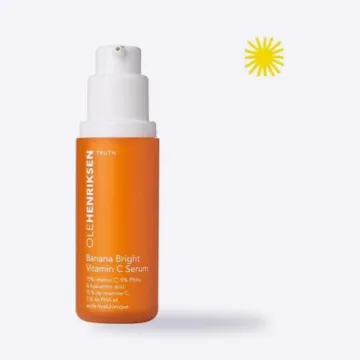
Banana Bright Vitamin C Serum
Serum with 3-O-Ethyl ascorbic acid, gluconolactone and ascorbic acid.
Suits: Normal, Dry, Oily, Combination skin
From Pori's catalogue. Amazon links carry our Associates tag: Pori earns from qualifying purchases, at no cost to you. No brand pays to be listed. Photos: Open Beauty Facts contributors, CC BY-SA 3.0.
What are the oil-soluble vitamin C derivatives?
Tetrahexyldecyl ascorbate (THD)
THD is an oil-loving form that shows up in oils, creams and anhydrous serums. The 2026 review describes it as suitable for sensitive skin and stable at a pH up to 6.5, much gentler than L-ascorbic acid. It adds a warning: on its own, THD may rapidly degrade unless combined with acetyl zingerone, an antioxidant that protects it. If THD is the form you want, look for acetyl zingerone on the same label.
Ascorbyl palmitate
Ascorbyl palmitate is vitamin C joined to a fatty acid. The Indian review describes it as a lipophilic antioxidant that hydrolyses to vitamin C and palmitic acid. In the pig-skin study it was one of the derivatives that didn't raise skin vitamin C levels, so don't count it as your vitamin C step.
Which form of vitamin C has the best evidence?
Ranked by the depth of published human data, the order is roughly:
- L-ascorbic acid at 10 to 20%, ideally with vitamin E and ferulic acid. The 2026 review found low-pH stabilized systems and vitamin C, E and ferulic acid complexes consistently improved photoaging and pigment.
- Ascorbyl glucoside and SAP, each with controlled trials for one main use: pigment for the glucoside, acne for SAP.
- THD with acetyl zingerone, with small but promising trials.
- MAP, ethyl ascorbic acid and ascorbyl palmitate, with mostly small, lab or short-term studies.
The Al-Niaimi review sums up the trade-off: derivatives are stable at neutral pH, yet daily application of MAP, ascorbyl-6-palmitate and other derivatives did not increase L-ascorbic acid in the skin in the absorption work. A derivative can still help through its own effects; just expect less certainty.
How do you choose a type of vitamin C?
- Your skin is resilient and you want the proven option: L-ascorbic acid 10 to 15% in an opaque, airtight bottle.
- L-ascorbic acid stings or you're sensitive: THD with acetyl zingerone, or ascorbyl glucoside.
- You're acne-prone: SAP, which has the controlled acne trial.
- Dark spots are the main goal: L-ascorbic acid or ascorbyl glucoside, with daily sunscreen. Our vitamin C serums for dark spots compares products.
- You keep throwing away orange serums: any derivative, or a smaller bottle of L-ascorbic acid you'll finish within a few months.
Whatever the form, vitamin C supports sunscreen and doesn't replace it. The Indian review notes that vitamin C does not absorb UV light; it helps by neutralizing free radicals. It also says vitamin C can safely be used alongside sunscreens, tretinoin, other antioxidants and glycolic acid. For first-time buyers, see the best vitamin C serums for beginners, and for where vitamin C fits beside other serums, types of serums and how to layer serums.
How can you tell how much vitamin C a product has?
Usually you can't, unless the brand states a percentage. Ingredient lists go in descending order down to 1%, so a vitamin C form in the first five ingredients is likely meaningful, and one listed after the preservatives and fragrance is a small amount. Our guide to reading ingredient labels explains the rules. For L-ascorbic acid, also look for a stated pH or an explanation of how the formula is stabilized, such as a water-free base, since the form only gets into skin under the right conditions.
Frequently asked questions
What are the types of vitamin C in skincare?
L-ascorbic acid (listed as ascorbic acid) and its derivatives: sodium ascorbyl phosphate, magnesium ascorbyl phosphate, ascorbyl glucoside, 3-O-ethyl ascorbic acid, tetrahexyldecyl ascorbate and ascorbyl palmitate.
Which form of vitamin C is best?
L-ascorbic acid at 10 to 20% has the most evidence, especially with vitamin E and ferulic acid. If it stings, ascorbyl glucoside or tetrahexyldecyl ascorbate with acetyl zingerone are gentler options with less research.
What pH does vitamin C need?
L-ascorbic acid needs a pH below 3.5 to get into the skin. Most derivatives work at a gentler pH; tetrahexyldecyl ascorbate is stable up to about pH 6.5.
Is ethyl ascorbic acid better than L-ascorbic acid?
It's more stable and usually less stinging, but it has far less human evidence. Lab studies show it reaches pig skin, while L-ascorbic acid has decades of clinical trials.
Which vitamin C is best for acne-prone skin?
Sodium ascorbyl phosphate. A 50-person randomized trial found a 5% lotion improved acne more than the vehicle over 12 weeks, with similar side effects.
Can vitamin C replace sunscreen?
No. Vitamin C does not absorb UV light. It neutralizes some of the free radicals UV creates, so it works best under a broad-spectrum sunscreen.
Sources
- Pinnell SR et al. Topical L-ascorbic acid: percutaneous absorption studies. Dermatol Surg, 2001 (PubMed)
- Telang PS. Vitamin C in dermatology. Indian Dermatol Online J, 2013 (PMC)
- Al-Niaimi F, Chiang NYZ. Topical vitamin C and the skin: mechanisms of action and clinical applications. J Clin Aesthet Dermatol, 2017 (PMC)
- Boghosian T et al. Clinical applications of vitamin C in dermatology: a systematic review. J Clin Aesthet Dermatol, 2026 (PMC)
- Woolery-Lloyd H et al. Sodium L-ascorbyl-2-phosphate 5% lotion for the treatment of acne vulgaris. J Cosmet Dermatol, 2010 (PubMed)
- Iliopoulos F et al. 3-O-ethyl-l-ascorbic acid: characterisation and investigation of single solvent systems for delivery to the skin. Int J Pharm X, 2019 (PMC)
- Lin FH et al. Ferulic acid stabilizes a solution of vitamins C and E and doubles its photoprotection of skin. J Invest Dermatol, 2005 (PubMed)
Pori is a wellness and skincare education app, not a medical device. This article is for general information and isn't medical advice. For anything that worries you, see a dermatologist.