Pori

- Skincare uses sodium hyaluronate, hydrolyzed (low molecular weight) HA, sodium hyaluronate crosspolymer and sodium acetylated hyaluronate; all hold water in the skin.
- Low molecular weight HA (20 to 300 kDa) passes the outer skin layer; high molecular weight HA stays on the surface.
- Every size improved hydration in a 60-day trial; only the smallest reduced wrinkle depth, in one small study.
- No controlled study shows HA dries skin in dry air; use it on damp skin under a moisturizer.
The main types of hyaluronic acid in skincare are high molecular weight sodium hyaluronate, low molecular weight or hydrolyzed hyaluronic acid, sodium hyaluronate crosspolymer and sodium acetylated hyaluronate. All of them are humectants that hold water in the top layer of skin. They differ in chain size, which changes how far they get into the skin and how long they last on it, and only the size question has real human data behind it.
If you want to know which forms a serum actually contains, you can scan its barcode or label with the ingredient scanner in Pori and check it against your skin type. It reads the formula; it doesn't diagnose skin conditions.
Below we explain molecular weight, go through each form you'll see on an ingredient list, sum up what the studies show, and check the popular claim that hyaluronic acid dries your skin out in a dry climate. For the step-by-step routine, see our guide on how to use hyaluronic acid.
What is hyaluronic acid, and why does the type matter?
Hyaluronic acid (HA) is a long sugar chain your body makes itself. A review in Dermato-Endocrinology notes that skin holds about 50% of the body's total HA, that HA in intact tissue is usually larger than 1,000 kilodaltons (kDa), and that it turns over fast: its half-life in skin is less than a day. Cleveland Clinic puts its water-holding power in kitchen terms: a quarter-teaspoon of HA holds about one and a half gallons of water.
The HA in skincare is made by bacterial fermentation or taken from rooster combs, according to the Cosmetic Ingredient Review. Manufacturers can then cut the chains shorter, link them together or attach new chemical groups. Each change gets its own name on the ingredient list, and that's where the "types" come from.
What do low and high molecular weight hyaluronic acid mean?
Molecular weight is the length of the chain, measured in kDa. Long chains are too big to pass the outer layer of skin, so they sit on top and form a thin, water-holding film. Short chains can get into the upper layers.
A study in Skin Research and Technology tracked HA of three sizes in human skin samples with Raman imaging. HA of 20 to 300 kDa passed through the stratum corneum, the outermost layer, while HA of 1,000 to 1,400 kDa did not.
Whether that deeper reach matters for your face is a separate question. In the best-known trial, 76 women aged 30 to 60 used 0.1% HA creams of five sizes (50, 130, 300, 800 and 2,000 kDa) around one eye and a plain cream around the other for 60 days. Every size improved hydration and elasticity compared with the plain cream. Only the 50 and 130 kDa creams reduced wrinkle depth. That's one study with small groups for each size, so it's a hint in favor of smaller chains for fine lines and no proof.
| Size | Where it works | What the evidence shows |
|---|---|---|
| High (about 1,000 kDa and up) | Stays on the surface as a film | Hydration and elasticity improved in the 60-day trial; no change in wrinkle depth |
| Medium (roughly 300 to 800 kDa) | Mostly the surface | Hydration and elasticity improved; no change in wrinkle depth |
| Low (roughly 50 to 300 kDa) | Reaches into the outer layers | The only sizes that reduced wrinkle depth, in one small trial |
What are the types of hyaluronic acid on an ingredient list?
US ingredient lists use standard INCI names. These are the ones you'll meet most often:
| INCI name | What it is | What it's used for | How strong the evidence is |
|---|---|---|---|
| Hyaluronic acid | The acid form of the chain | Surface hydration | Good for hydration; size rarely stated |
| Sodium hyaluronate | The salt form, the one most products use | Surface hydration; dissolves easily in water | Good; most studies use it |
| Hydrolyzed hyaluronic acid | HA cut into short chains | Low molecular weight hydration | Fits the low-weight data above |
| Sodium hyaluronate crosspolymer | Chains linked into a network | A longer-lasting moisture film | Mostly supplier claims |
| Sodium acetylated hyaluronate | HA with acetyl groups added | Hydration plus a softer feel | One small manufacturer study |
| Potassium hyaluronate | Another salt form | Surface hydration | Covered by the same safety review; little else |
Sodium hyaluronate
Sodium hyaluronate is the salt form of HA and the most common one in skincare, because it dissolves easily in water-based formulas. On a label it does the same job as "hyaluronic acid." The catch is that neither name tells you the chain size, and the size can be anything from a few kDa to well over 1,000. Some brands print the weights on their product pages; most don't.
Hydrolyzed hyaluronic acid
Hydrolysis breaks HA into shorter pieces, so "hydrolyzed hyaluronic acid" is the label's way of saying low molecular weight. It's the form that matches the sizes that got through the outer skin in the Raman study and reduced wrinkle depth in the eye-area trial. Many "multi-weight" serums pair it with regular sodium hyaluronate to cover both the surface and the upper layers.
Sodium hyaluronate crosspolymer
Crosslinking ties HA chains together into a mesh. Fillers use the same idea to make HA last longer in the skin, though a cream is a very different product. In skincare, COSMILE Europe, the European cosmetics ingredient database, lists its functions as humectant and skin conditioning. Claims that it hydrates for longer than plain HA come mostly from ingredient suppliers. We found no independent clinical study that tests it against regular sodium hyaluronate on skin.
Sodium acetylated hyaluronate
Researchers at Shiseido attached acetyl groups to HA to make it bind to skin better. They called it AcHA, and its weight was about 150 kDa compared with 1,200 kDa for the HA they started with. In their paper in the Journal of Cosmetic Science, AcHA raised stratum corneum water content more markedly than HA and a 0.2% lotion improved dry skin. The work comes from the company that made the ingredient, used animal skin for part of the testing and was small, so treat it as promising and unconfirmed.
What does the evidence actually show?
- HA hydrates. Every size in the 60-day trial improved hydration and elasticity at just 0.1%, so a big percentage on the front of the bottle isn't needed.
- Smaller chains reach further. Low molecular weight HA (20 to 300 kDa) gets past the outer layer; high molecular weight HA does not.
- Smaller chains may help fine lines a little. Only one controlled trial shows it, with small groups.
- It's safe. The Cosmetic Ingredient Review panel concluded that HA and its sodium and potassium salts, used at concentrations up to 2%, are safe in cosmetics, and found no sign that HA is a sensitizer in animal studies. Cleveland Clinic calls reactions to HA rare and says it's safe during pregnancy and nursing.
- Crosslinked and acetylated forms are less proven. Their extra benefits rest on supplier data and one small manufacturer study.
One open question: inside the body, small HA fragments act as distress signals. The same Dermato-Endocrinology review notes that large HA in intact tissue calms the immune response, while smaller polymers can trigger inflammation. That finding comes from tissue biology, and we found no study showing that low molecular weight HA in a serum irritates skin. Still, if a "low molecular weight" serum stings when plainer HA products don't, switch.
Does hyaluronic acid dry out your skin in a dry climate?
The claim goes like this: HA pulls water from wherever it can, so in dry air it pulls water out of your skin and leaves you drier than before. The sources don't back the strong version of that claim.
The part that's true is the mechanism. A review of moisturizers in the Indian Journal of Dermatology explains that humectants draw water from two places: from the dermis into the epidermis, and from the air when it's humid. Water drawn up into the outer layer can then evaporate, which is why the authors say humectants are usually combined with occlusives that slow that loss.
The part that isn't backed up is that HA makes skin drier in dry air. We found no controlled study showing it. The one controlled test we found was run in a room set to 30% humidity, which is drier than most homes in winter. Twenty women applied a fluid with 1% HA and 5% glycerin to one forearm and nothing to the other. Hydration on the treated arm was 59% higher after 1 hour and still 29% higher after 24 hours, and water loss through the skin was lower than on the untreated arm. That study tested a multi-ingredient product on forearms, so it doesn't settle the question for every serum. It does cut against the idea that HA dries skin in dry air.
What the evidence supports is simple. In dry air, put HA on damp skin and a moisturizer on top. The AAD also recommends ceramides and hyaluronic acid in moisturizers for dry skin. If your face feels tight an hour after an HA serum on its own, add a cream over it before you give up on the serum. Our guides to dry vs. dehydrated skin and skin type and climate go further.
Which type of hyaluronic acid should you choose?
- For everyday hydration: any serum or moisturizer with sodium hyaluronate high on the list. Size matters less than a moisturizer on top.
- For fine lines: a multi-weight formula that includes hydrolyzed HA or states a low molecular weight, used alongside a proven anti-aging step such as a retinoid at night and sunscreen in the morning.
- For sensitive skin: a short, fragrance-free formula. If a low molecular weight serum stings, try one with plain sodium hyaluronate instead.
- For oily skin: HA is oil-free, so a light serum under a gel moisturizer works. See oily but dehydrated skin.
The Ordinary Hyaluronic Acid 2% + B5 lists several HA forms in a short, fragrance-free formula and costs little, and L'Oréal Paris Revitalift 1.5% Pure Hyaluronic Acid Serum is a fragrance-free drugstore option. We compared published ingredient lists and brand claims; we did not test these products on skin. Our The Ordinary Hyaluronic Acid review and best hyaluronic acid serums compare more.
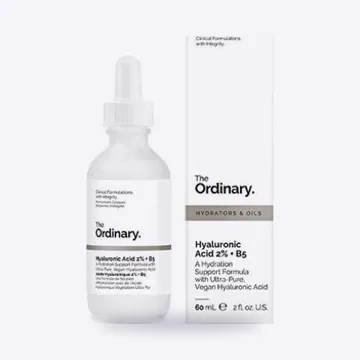
Hyaluronic Acid 2% + B5
Water-binding layer under moisturiser for tight, thirsty skin.
Suits: Dry, Normal, Combination, Oily, Sensitive skin
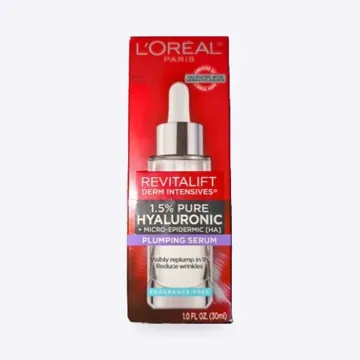
Revitalift 1.5% Pure Hyaluronic Acid Serum for Face
Serum with ascorbyl glucoside, hyaluronic acid and glycerin. Fragrance-free.
Suits: Normal, Dry, Oily, Combination, Sensitive skin
From Pori's catalogue. Amazon links carry our Associates tag: Pori earns from qualifying purchases, at no cost to you. No brand pays to be listed. Photos: Open Beauty Facts contributors, CC BY-SA 3.0.
How do you read HA claims on a label?
- "Multi-weight" or "3x hyaluronic": two or more forms or sizes. Look for hydrolyzed HA or a crosspolymer in the list to confirm.
- "Holds 1,000 times its weight in water": this describes the raw ingredient in a lab. It tells you nothing about how a finished serum performs on skin.
- Position in the list: HA is effective at low levels, so it often sits mid-list or lower. That's normal.
HA pairs well with almost everything else in a routine, including retinoids, acids, vitamin C and niacinamide. For the order of steps, see how to layer serums, and for how HA differs from other humectants such as glycerin, read glycerin in skincare.
Frequently asked questions
What is the best type of hyaluronic acid for skin?
For hydration, any size works; a trial found all five sizes tested improved hydration at 0.1%. For fine lines, low molecular weight or hydrolyzed HA has slightly better evidence, from one small study. Multi-weight serums combine both.
Is sodium hyaluronate the same as hyaluronic acid?
Practically, yes. Sodium hyaluronate is the salt form of hyaluronic acid and the form most skincare uses. Neither name tells you the chain size.
Is low molecular weight hyaluronic acid better?
It gets further into the outer layers of skin, and in one 60-day trial only the smallest sizes reduced wrinkle depth. All sizes hydrated, so for hydration alone it isn't clearly better.
What is sodium hyaluronate crosspolymer?
It's hyaluronic acid with its chains linked into a network, used as a humectant that forms a longer-lasting film. Claims that it beats regular HA come mostly from suppliers, not independent studies.
Does hyaluronic acid dry out your skin in a dry climate?
There's no controlled study showing that. Humectants can draw water up from deeper skin, where it can evaporate, so apply HA to damp skin and seal it with a moisturizer in dry air.
Can hyaluronic acid cause irritation?
Rarely. Safety reviewers consider HA and its salts safe in cosmetics up to 2%. If a serum stings, the cause is more often another ingredient, such as fragrance or alcohol, than the HA itself.
Sources
- Cleveland Clinic: Hyaluronic acid
- Papakonstantinou E, Roth M, Karakiulakis G. Hyaluronic acid: a key molecule in skin aging. Dermatoendocrinol, 2012 (PMC)
- Essendoubi M et al. Human skin penetration of hyaluronic acid of different molecular weights as probed by Raman spectroscopy. Skin Res Technol, 2016 (PubMed)
- Pavicic T et al. Efficacy of cream-based novel formulations of hyaluronic acid of different molecular weights in anti-wrinkle treatment. J Drugs Dermatol, 2011 (PubMed)
- Becker LC et al. Final report of the safety assessment of hyaluronic acid, potassium hyaluronate, and sodium hyaluronate. Int J Toxicol, 2009 (PubMed)
- Oka T, Uemura M, Ueno N, Yanaki T. Skin-softening effect of acetylhyaluronate on stratum corneum. J Cosmet Sci, 1999 (SCC library)
- COSMILE Europe: Sodium hyaluronate crosspolymer
- Sethi A et al. Moisturizers: the slippery road. Indian J Dermatol, 2016 (PMC)
- Milani M, Sparavigna A. The 24-hour skin hydration and barrier function effects of a hyaluronic 1%, glycerin 5%, and Centella asiatica stem cells extract moisturizing fluid. Clin Cosmet Investig Dermatol, 2017 (PubMed)
- American Academy of Dermatology: How to pick the right moisturizer for your skin
Pori is a wellness and skincare education app, not a medical device. This article is for general information and isn't medical advice. For anything that worries you, see a dermatologist.