Pori
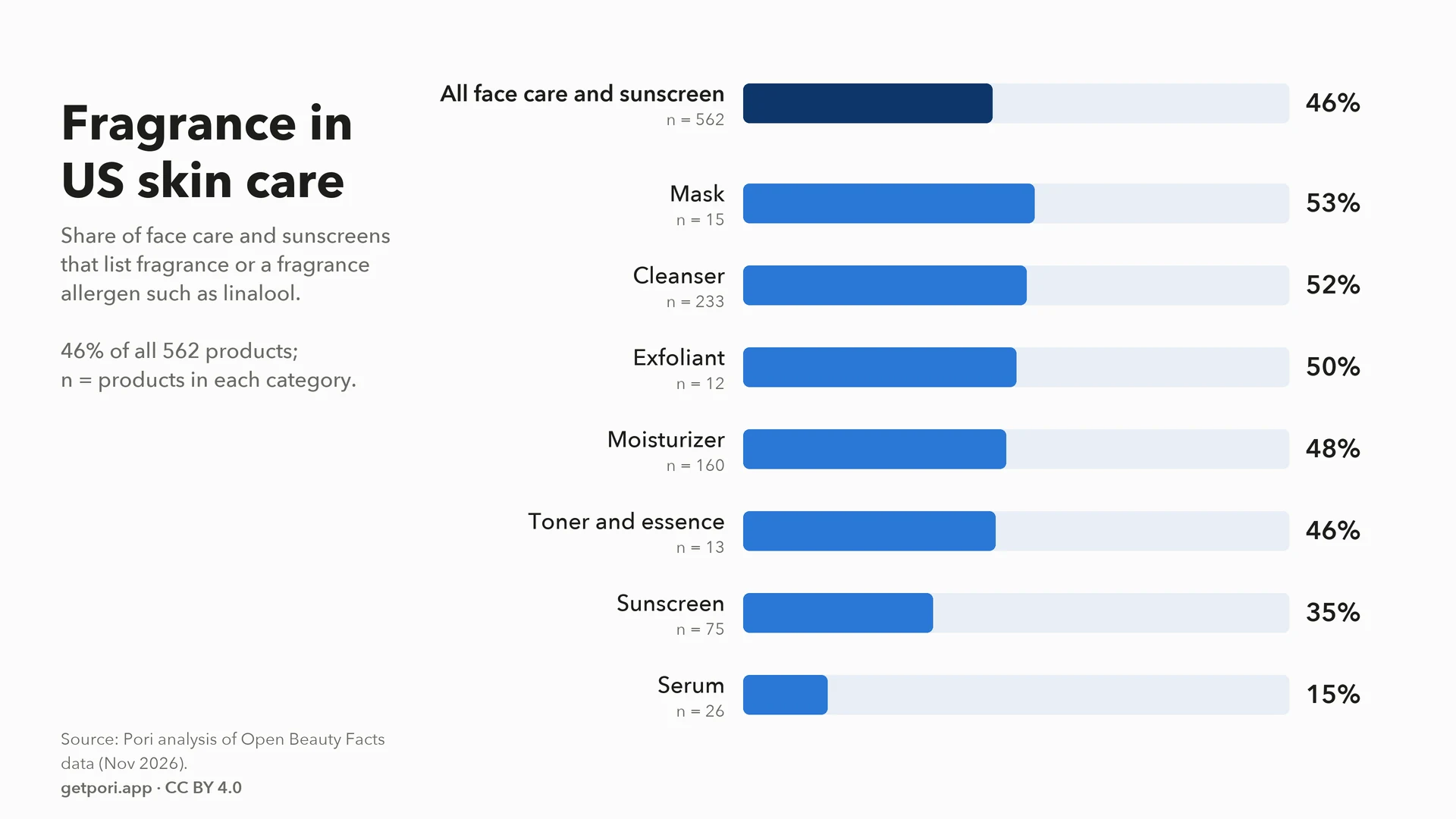
- 46% of 562 US face care products and sunscreens in Open Beauty Facts list fragrance or a named fragrance allergen; 56% with essential oils.
- Cleansers are the most often scented big category (52% of 233), then moisturizers (48% of 160), sunscreens (35% of 75) and serums (15% of 26).
- 37% of face products named sensitive, gentle, calming or baby still list fragrance (18 of 49); none of 25 fragrance-free or unscented claims was contradicted by its list.
- Linalool (13%) and limonene (11%) are the most common allergens; the data and CSV are free to reuse under CC BY 4.0.
Nearly half of the face care and sunscreen products sold in the US in our data list fragrance or a named fragrance allergen: 256 of 562 products, or 46%. Counting essential oils as well, 56% contain at least one scent ingredient. We read the full ingredient lists of every US face product with a list in Open Beauty Facts, an open, crowd-sourced product database, and found that products with "sensitive", "gentle", "calming" or "baby" in the name are less likely to be scented, yet more than a third of them still list fragrance.
To check a product you already own, scan its barcode or label with the ingredient scanner in Pori, which flags fragrance, fragrance allergens and essential oils and checks the list against your skin type. Pori does not diagnose skin conditions.
What did we find?
- 46% of face care and sunscreens list fragrance or a fragrance allergen (256 of 562; 95% margin roughly 42% to 50%). 39% (218) use the word fragrance, parfum, aroma or flavor; 18% (102) name at least one of the fragrance allergens EU law makes brands declare.
- Add essential oils and it is 56% (314 of 562). 111 products (20%) contain an essential oil, and 58 of those list no fragrance and no declared allergen, so a shopper reading only for the word "fragrance" would miss them.
- Cleansers are the most often scented big category: 52% of 233 cleansers list fragrance or an allergen, against 48% of 160 moisturizers, 35% of 75 sunscreens and 15% of 26 serums.
- "Sensitive" names help, but less than you might hope. 37% of products whose names say sensitive, gentle, calming or baby (18 of 49) list fragrance or an allergen, against 46% of the rest (238 of 513). Across all skin and body care the gap is clearer: 47% (47 of 99) against 63% (701 of 1,116).
- Fragrance-free claims held up. None of the 25 skin and body care products that say fragrance-free or unscented on the name or label lists fragrance, a declared allergen or an essential oil. Two cleansers sold without such a claim list "masking fragrance", an ingredient used to cover a base smell.
- Linalool and limonene lead the allergens, in 13% (74) and 11% (64) of face products.
- Brands differ sharply. Of the four brands with at least 15 face products in the data, CeraVe listed fragrance in none of 21 and Neutrogena in 12 of 16.
Which kinds of skin care are most likely to contain fragrance?
We sorted products into categories by the words in their names. The table gives every category with its sample size; small categories have wide margins of error, so read anything under about 30 products as a rough signal. "Fragrance or allergen" is our headline measure. "Any scent ingredient" adds essential oils. You can download the full data as a CSV, with 95% confidence intervals for each share.
| Category | Products | Fragrance or allergen | Fragrance allergen named | Essential oil | Any scent ingredient |
|---|---|---|---|---|---|
| All face care and sunscreen | 562 | 46% (256) | 18% (102) | 20% (111) | 56% (314) |
| Cleanser | 233 | 52% (121) | 22% (51) | 29% (67) | 67% (155) |
| Moisturizer | 160 | 48% (77) | 22% (35) | 8% (12) | 49% (79) |
| Sunscreen | 75 | 35% (26) | 5% (4) | 8% (6) | 41% (31) |
| Serum | 26 | 15% (4) | 8% (2) | 31% (8) | 42% (11) |
| Mask | 15 | 53% (8) | 33% (5) | 20% (3) | 67% (10) |
| Toner and essence | 13 | 46% (6) | 8% (1) | 15% (2) | 54% (7) |
| Exfoliant | 12 | 50% (6) | 17% (2) | 50% (6) | 75% (9) |
| Eye care | 6 | 0% (0) | 0% (0) | 0% (0) | 0% (0) |
| Lip care (reported separately) | 44 | 66% (29) | 32% (14) | 25% (11) | 75% (33) |
Two patterns stand out. Cleansers carry the most essential oils (29%), so a wash that says nothing about fragrance can still smell of lavender or citrus. Serums rarely list fragrance (15%), but 8 of 26 contain an essential oil; half of those come from a single brand with many serums in the data, so treat the serum figure with care. Lip balms are the most scented of all, mostly through flavor, which US labels may list simply as "Flavor". We kept lip care and after-sun products out of the headline figure.
Are "sensitive skin" and "baby" products fragrance-free?
More often than other products, but far from always. We flagged products whose brand or name contains sensitive, gentle, calming, calm or baby.
| Group | Products | Fragrance or allergen | Any scent ingredient |
|---|---|---|---|
| Face and sun care, name says sensitive, gentle, calming or baby | 49 | 37% (18) | 37% (18) |
| Face and sun care, all other names | 513 | 46% (238) | 58% (296) |
| All skin and body care, name says sensitive, gentle, calming or baby | 99 | 47% (47) | 49% (49) |
| All skin and body care, all other names | 1,116 | 63% (701) | 72% (801) |
In face care alone the gap in fragrance or allergens (37% against 46%) is small enough to be chance (p = 0.19). The gap in any scent ingredient (37% against 58%) is not (p = 0.005): "sensitive" face products rarely add essential oils (2 of 49) or name allergens (4 of 49). In the larger set of all skin and body care, which includes washes, lotions, wipes and some deodorants, the gap in fragrance or allergens is clear (p = 0.003). The words "gentle" and "sensitive" have no legal definition, and the FDA says the same of "hypoallergenic": there are no federal standards for it, and it means whatever a company wants it to mean.
Do "natural" and "organic" products contain more fragrance?
Our data cannot say. Only 9 face products and 30 skin and body care products have natural or organic in the brand or name, and their shares (67% in both sets) are not reliably different from the rest (p = 0.20 and 0.56). We also planned to test the word "clean" and dropped it: in this data it almost always describes cleansing ("Deep Clean", "Gentle & Clean"), not a clean-beauty claim. Plant-derived scent is still scent: essential oils naturally contain the same allergens, such as linalool and limonene, that EU law makes brands name.
Which brands list fragrance most and least?
Few brands have enough products in Open Beauty Facts to compare fairly. We ranked only brands with at least 15 products, as the brand was entered in the database.
| Brand | Face and sun products | Fragrance or allergen | Essential oil |
|---|---|---|---|
| Neutrogena | 16 | 75% (12) | 0 |
| Aveeno | 15 | 33% (5) | 0 |
| CeraVe | 21 | 0% (0) | 0 |
| Swiss Toniq Geneva | 26 | 0% (0) | 50% (13) |
Widening to all skin and body care adds three brands that sell mostly soaps, washes, lotions and deodorants: Bath & Body Works (fragrance in 30 of 30 products; 27 of 30 also name an allergen), Dr. Squatch (18 of 21) and Native (19 of 23). Aveeno is at 10 of 28 and CeraVe at 0 of 23 in that wider set. These are counts of what volunteers happened to scan, not a brand's whole range: a brand's share would change with a different mix of products.
Which fragrance allergens show up most?
EU law requires brands to name certain fragrance allergens on the label when they pass a small threshold, and some US labels name them too. Of 562 face and sun products, these named allergens appear most often:
- Linalool: 74 products (13%)
- Limonene: 64 (11%)
- Citronellol: 31 (6%)
- Geraniol: 27 (5%)
- Hexyl cinnamal: 15 (3%); benzyl salicylate and coumarin: 13 each (2%)
We left benzyl alcohol out of these counts. It is on the EU allergen list but is mostly used as a preservative. It appears in 62 face products; counting it would raise the headline share from 46% to 49%.
What does US law say about fragrance on labels?
Under US rules, fragrance and flavor ingredients can be listed simply as "Fragrance" or "Flavor", because the formula can be a trade secret. The FDA says some components of fragrance formulas may cause allergic reactions or sensitivities in some people, and that even some products labeled "unscented" may contain fragrance ingredients. The Modernization of Cosmetics Regulation Act of 2022 requires the FDA to set rules for fragrance allergen labeling; as of November 2026 the FDA's MoCRA page lists no final rule on it. Until there is one, a US label that says only "Fragrance" can hide dozens of compounds, and named allergens like linalool appear mainly when a brand also sells in Europe or chooses to list them.
Dermatologists treat fragrance as a leading cause of skin allergy. The AAD calls fragrance one of the most common causes of contact dermatitis and warns that a fragrance that has been covered up can still cause an allergic reaction. For people with rosacea it advises choosing fragrance-free rather than unscented products.
What does this mean when you shop?
- Read the list, not the front. Look for fragrance, parfum, aroma or flavor, any named allergen such as linalool or limonene, and plant oils such as lavender, citrus peel, peppermint, eucalyptus, geranium or tea tree. Our guide to fragrance and essential oils in skincare explains each.
- Prefer "fragrance-free" to "unscented". In our data, products that claimed fragrance-free or unscented kept their word, but "masking fragrance" turned up in two cleansers, and the AAD and FDA both warn that unscented can still mean fragrance.
- Do not stop at "sensitive" or "baby". More than a third of face products with those words still listed fragrance.
- Check cleansers and lip balms twice. They were the most often scented.
- Patch test new products if you react easily; our guide to patch testing skincare shows how. A rash that keeps coming back deserves a visit to a dermatologist, who can patch test you for specific allergens; see contact dermatitis on the face.
How did we count?
We started from Pori's snapshot of Open Beauty Facts built on November 12, 2026 (21,665 products with an ingredient list), which powers our product catalogue. We kept products whose sold-in countries include the United States (2,685) and read each one's full ingredient list from the Open Beauty Facts data export of November 16, 2026. We dropped 114 barcodes that repeated a product already counted under the same brand and name, leaving 2,571.
The headline set is Open Beauty Facts' face and skin care group plus its sun care group, without lip care, after-sun products and items whose names show they are for the body, feet, hands, shaving or hair: 562 products from 245 brands. The wider "skin and body care" set (1,215 products) adds the body and baby groups. Categories, the sensitive and natural comparisons and fragrance-free claims come from words in the product's brand, name or Open Beauty Facts labels.
A product counts as listing fragrance if any ingredient is fragrance, parfum, perfume, aroma or flavor (including "natural fragrance" and "masking fragrance", excluding phrases like "fragrance-free"). It counts as naming an allergen if it lists one of the 26 fragrance allergens in Annex III of the EU Cosmetics Regulation, except benzyl alcohol. Essential oils are ingredients named as essential oils or the oil of an aromatic plant (lavender, citrus peel, mint, eucalyptus, geranium, rose flower, tea tree and dozens of others), excluding oils pressed from seeds, kernels and nuts. Margins of error are 95% Wilson intervals; comparisons use a two-proportion z-test. The code that does all this, research_fragrance.py, runs on the published data.
What are the limits of this study?
- Open Beauty Facts is crowd-sourced. Volunteers add products they happen to scan, so the data over-represents some brands (one Swiss brand has 26 face products) and is not a random sample of what Americans buy. Shares here describe these 562 products, not the US market.
- Labels change. 32% of the face products were last edited in 2021 or earlier. A brand may have removed or added fragrance since.
- Typed and photographed lists have errors. Some lists are misspelled or cut off, a few products tagged as US carry another country's label, and some brand fields are blank (65 face products) or name a parent company.
- Categories come from names. A body lotion with no "body" in its name may sit among the moisturizers.
- Listing is not dose. An ingredient list says what is in a product, not how much, or whether it will bother your skin. Many people use fragranced products without trouble.
- Fragrance-free claims are a small sample. 25 products made the claim; that none listed fragrance is reassuring but cannot prove every claim on the market holds.
Can I use this data?
Yes. The tables, the CSV and the findings are free to republish under CC BY 4.0. Please credit "Pori" and link to this page. The CSV has every figure above with its sample size and margin of error, so reporters can build their own story from it. A ready-to-use chart of fragrance by product category (PNG) is free to reuse on the same terms. The underlying product data come from Open Beauty Facts under the Open Database License.
Frequently asked questions
What share of skin care products contain fragrance?
In our analysis of 562 US face care products and sunscreens in Open Beauty Facts, 46% list fragrance or a named fragrance allergen, and 56% contain fragrance, an allergen or an essential oil. The data are crowd-sourced, so treat these as estimates for the products in the database, not the whole market.
Are products for sensitive skin fragrance-free?
Not always. Of 49 face products whose names say sensitive, gentle, calming or baby, 18 (37%) list fragrance or a fragrance allergen. They do contain essential oils and named allergens less often than other products.
What is the difference between fragrance-free and unscented?
Neither term has a legal definition in the US. Dermatologists advise choosing fragrance-free, because unscented products can contain a masking fragrance that covers other smells and can still cause a reaction.
Which fragrance allergens are most common in skin care?
Linalool (in 13% of the 562 face products we checked) and limonene (11%), followed by citronellol (6%) and geraniol (5%).
Why can't I see what is in "fragrance" on a US label?
US rules let brands list fragrance ingredients simply as Fragrance, because the formula can be a trade secret. A 2022 law requires the FDA to write rules for fragrance allergen labeling, and as of November 2026 the FDA has not listed a final rule.
Can I use these numbers in an article?
Yes. The data and findings are free to republish under CC BY 4.0. Credit Pori and link to this page; the CSV has every figure with its sample size.
Sources
- Open Beauty Facts: open database of cosmetic products (data export of November 16, 2026)
- FDA: Fragrances in Cosmetics
- FDA: Modernization of Cosmetics Regulation Act of 2022 (MoCRA)
- FDA: Hypoallergenic Cosmetics
- American Academy of Dermatology: Itchy rash could be contact dermatitis
- American Academy of Dermatology: 7 rosacea skin care tips dermatologists recommend
- American Academy of Dermatology: A dermatologist's guide to skincare from growing up to glowing up (2025)
- Regulation (EC) No 1223/2009 on cosmetic products (EU), Annex III
Pori is a wellness and skincare education app, not a medical device. This article is for general information and isn't medical advice. For anything that worries you, see a dermatologist.