Pori

- Your cheeks decide it: shiny cheeks mean oily skin, matte or tight cheeks with a shiny T-zone mean combination.
- Check shine one to two hours after washing, and blot five zones separately.
- Summer, humidity and hormones raise oil output, so test in at least two seasons.
- Oily skin can use light, oil-controlling products everywhere; combination skin needs more moisture on the cheeks.
The quickest way to tell oily vs combination skin is to watch your cheeks. Wash, apply nothing, and check your face after one to two hours. If your cheeks shine and blotting paper from them picks up oil, you're oily. If only your forehead, nose and chin shine while your cheeks stay matte, comfortable or tight, you're combination. Repeat in another season to be sure.
Below is a side-by-side diagnostic: where shine appears and when, what your pores and blotting papers tell you zone by zone, why humidity and seasons blur the line, and how your product choices should differ once you know which one you have.
What is the main difference between oily and combination skin?
The difference is where the oil goes. Oily skin produces enough sebum to shine across the whole face, cheeks included. Combination skin is oily in the T-zone and normal or dry on the cheeks and outer face.
This is easy to misjudge, because almost everyone's T-zone is oilier than their cheeks. A year-long study that measured sebum at five facial sites found oil on the forehead, nose and chin was higher than on both cheeks in the same volunteers. So a greasy nose tells you little. Your cheeks decide the answer. For the full definition of the second type, see what is combination skin.
| Sign | Oily skin | Combination skin |
|---|---|---|
| Shine 1 to 2 hours after washing | Forehead, nose, chin and cheeks | Forehead, nose and chin only |
| Cheeks after cleansing | Comfortable, soon shiny | Normal, or tight and dry |
| Pores | Visible on the nose and across the cheeks | Visible on the nose and chin, smaller-looking on the cheeks |
| Blotting papers | Oil on every sheet, cheeks included | Oil on T-zone sheets, little or none from the cheeks |
| Dry or flaky patches | Rare, unless products are too harsh | Common on the cheeks, especially in winter |
| Makeup by midday | Slides or separates all over | Slides on the nose, clings to dry patches on the cheeks |
| Moisturizer | Light gel feels like enough everywhere | Light on the T-zone, richer on the cheeks |
Where does shine show up after 1 to 2 hours?
On oily skin, shine spreads to the cheeks within an hour or two of washing; on combination skin, it stays in a T-shaped band down the center. To check:
- Wash with a gentle cleanser and pat dry. The AAD warns that a face wash that is too harsh can irritate skin and trigger increased oil production, which would skew the result.
- Apply nothing: no serum, moisturizer, sunscreen or makeup.
- Stay indoors, away from heat and exercise, and keep your hands off your face.
- After one hour, look at your face in daylight from the side, where shine is easier to see. Look again at two hours.
Pay attention to the outer cheeks near your ears and jaw. If they're shiny by the two-hour mark, that points to oily skin. If they're still matte, or they feel tight when you smile, that points to combination. Our guide on how to find your skin type covers the general test for all five types.
How do pores differ between your cheeks and nose?
On combination skin, pores usually look clearly larger on the nose and chin than on the cheeks. On oily skin, visible pores tend to extend out across the cheeks as well. Pore size tracks oil output: a review in Dermatologic Surgery names high sebum excretion as one of three major causes of enlarged facial pores, alongside reduced elasticity around the pore and larger hair follicles. Cleveland Clinic adds that pore size is genetic and determined by the size of your sebaceous glands.
Don't mistake the gray dots on your nose for a sign of oily skin on their own. These are often sebaceous filaments, which Cleveland Clinic calls a normal, healthy element of your skin that can look more noticeable when your body overproduces oil, most often on the nose, forehead, chin and cheeks. Everyone has them; how far they spread across your face is the useful clue.
Because age and sun damage also loosen the skin around pores, pore size is a supporting sign. Use it alongside shine and blotting, not as the only test.
What do blotting papers show by zone?
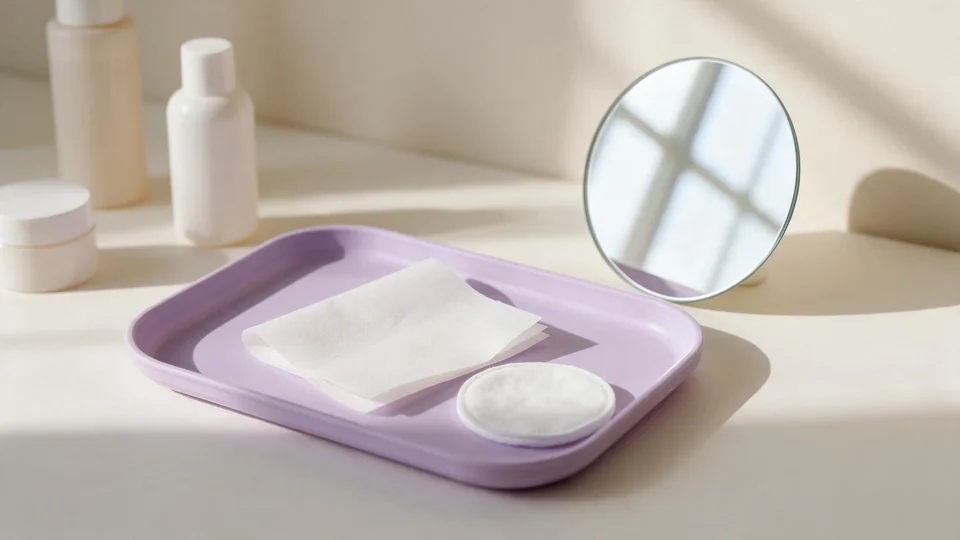
Blotting papers give you a visible answer: oily skin leaves oil on every sheet, while combination skin leaves oil on the T-zone sheets and little or nothing on the cheek sheets. Use five separate sheets: forehead, nose, chin, left cheek and right cheek. Follow the AAD technique and gently press the paper against your face for a few seconds without rubbing, since rubbing spreads oil to other areas.
- Oil on all five sheets, including both cheeks: oily skin.
- Oil on forehead, nose and chin; cheek sheets nearly clean: combination skin.
- A little oil on the nose only: likely normal skin.
- No oil anywhere and tightness: likely dry skin.
Write the result down with the date and the weather. A single afternoon can mislead you, and the notes make the seasonal pattern visible.
Can the seasons change the answer?
Yes, and this is the main reason people get different answers at different times of year. Summer raises oil output across the face, so combination skin can look oily in July and closer to normal or dry in January. In the year-long sebum study, summer was the highest sebum-secreting season, with seasonal variation in both the T-zone and the cheeks. A study of 100 Korean men also found sebum higher in summer than in winter, with more visible pores in summer and more sensitivity in winter.
Climate has the same effect. Cleveland Clinic notes that warmer weather favors oil production, so people in humid, tropical climates are more likely to have oily skin, while cooler temperatures tend to dry skin out. Hormones add another swing: the same article notes that oil glands can be more active in the luteal phase of the menstrual cycle.
The research gives a practical rule. The authors of the sebum study proposed that a mismatch between the T-zone and the cheeks in more than two seasons is closest to what people call combination skin. So test in at least two seasons. If your cheeks only shine in high summer, you're probably combination with a seasonal swing. If they shine year-round, you're oily. Our article on being oily in summer, dry in winter goes further into seasonal skin.
What else can make the two look alike?
A few situations confuse the test:
- Over-cleansing: harsh, drying products can leave cheeks tight and the T-zone oilier, making oily skin look like combination.
- Dehydration: skin can be shiny and tight at the same time, which feels like combination even if the whole face is oily.
- Recent products: a rich night cream or face oil can still be on the cheeks in the morning and make them look oilier than they are. Run the test after a gentle wash only.
- Heat and exercise: sweat looks like oil on blotting paper. Test at rest, indoors.
How should product choices differ for oily vs combination skin?
Oily skin can use the same lightweight, oil-controlling products across the whole face, while combination skin needs a split approach: oil control in the center and more moisture on the cheeks.
| Step | Oily skin | Combination skin |
|---|---|---|
| Cleanser | Gentle foaming cleanser, morning and night | Gentle, non-stripping cleanser; foaming is fine if cheeks don't tighten |
| Moisturizer | Light gel or oil-free lotion all over | Light lotion all over, extra cream on dry cheeks |
| Exfoliating acid (salicylic, glycolic) | Whole face, a few times a week if tolerated | T-zone only, or less often on the cheeks |
| Niacinamide serum | Whole face | Whole face or T-zone |
| Sunscreen | Oil-free, fragrance-free, SPF 30+ | Light, SPF 30+; a creamier formula if cheeks are dry |
The AAD recommends that people with oily skin use a gentle, foaming face wash and choose products labeled "oil free" and "noncomedogenic", and notes that salicylic, glycolic and lactic acid can reduce oiliness but may be too harsh for some people. It also suggests a moisturizer with broad-spectrum SPF 30 or higher, and sunscreens without fragrance or oils to prevent breakouts.
For combination skin, the AAD quotes a dermatologist who tells patients to treat their face as though it's two faces: moisturize the dry spots and skip the oily areas. For oily skin, the same page suggests considering a gel moisturizer or, for some people, skipping moisturizer altogether.
Niacinamide is a reasonable add-on for either type. In a split-face study of 30 Caucasian adults, a 2% niacinamide moisturizer significantly reduced casual sebum levels after six weeks, and a placebo-controlled trial in 100 Japanese adults found lower sebum excretion rates after two and four weeks.
For full routines, see the oily skin routine or the combination skin routine.
Can a skin scan help tell oily from combination skin?
Your own blotting tests are the best guide to oil, but a scan can help you see how texture and pores in each area change over months. Pori, an iPhone app, reads a selfie region by region using a 468-point face mesh and gives an overall skin score with categories including Pores & Texture and Hydration & Moisture, so you can compare summer and winter scans alongside your blotting notes. Its Pro ingredient scanner flags each ingredient in a product as beneficial, use with caution or avoid for your skin type.
A scan tracks appearance and is not a diagnosis. If you have painful breakouts, persistent redness, or scaly patches around the nose and eyebrows, see a dermatologist.
Frequently asked questions
How do I know if I have oily or combination skin?
Wash, apply nothing and check your skin after one to two hours. If your cheeks shine too, you're oily; if only your forehead, nose and chin shine, you're combination.
Am I oily or combination if only my nose is oily?
Probably neither oily nor strongly combination. Most people's noses are oilier than their cheeks, so a slightly oily nose with comfortable cheeks often means normal skin.
Can combination skin look oily in summer?
Yes. Sebum output peaks in summer and in humid climates, so cheeks that are normal in winter can shine in hot weather. Test in at least two seasons.
Do oily cheeks mean I have oily skin?
If your cheeks shine within a couple of hours of washing and blotting paper from them picks up oil, your skin is most likely oily rather than combination.
Should oily and combination skin use different moisturizers?
Oily skin usually does well with a light gel or oil-free lotion all over. Combination skin often needs a light lotion on the T-zone and a richer cream on dry cheeks.
Sources
- Youn SW et al. Regional and seasonal variations in facial sebum secretions: a proposal for the definition of combination skin type. Skin Res Technol, 2005 (PubMed)
- American Academy of Dermatology: How to control oily skin
- American Academy of Dermatology: How to pick the right moisturizer for your skin
- Cleveland Clinic: How to get rid of oily skin
- Lee SJ et al. Facial pores: definition, causes, and treatment options. Dermatol Surg, 2016 (PubMed)
- Cleveland Clinic: Sebaceous filaments
- Song EJ et al. A study on seasonal variation of skin parameters in Korean males. Int J Cosmet Sci, 2015 (PubMed)
- Draelos ZD et al. The effect of 2% niacinamide on facial sebum production. J Cosmet Laser Ther, 2006 (PubMed)
Pori is a wellness and skincare education app, not a medical device. This article is for general information and isn't medical advice. For anything that worries you, see a dermatologist.